Schrödinger's cat
Schrödinger's cat is a thought experiment. It came out in 1935. It was created by Erwin Schrödinger.
- Released
- 1935
- Created by
- Erwin Schrödinger
All 6 facts, and where they come from
Facts
6 facts · 0 confirmed by two sources · 0 cited · 6 from one source
Where this comes from
Papalocal keeps its own record. It started from these sources; what each one said is kept here as it was copied, so a change on their side never changes this page by itself. Tap one to read its version.
What Wikidata says · copied November 17, 2026 · revision 2562013074
- Described as
- thought experiment
- Other names
- Erwin Schrödinger's Cat
- What it is
- thought experiment; paradox; fictional cat
- Created by
- Erwin Schrödinger
- Released
- 1935
- Named after
- Erwin Schrödinger
- Wikipedias with a page
- 84
Wikidata item Q8588 (wikidata.org/wiki/Q8588), public domain (CC0). Copied 2026-11-17.
What Wikipedia says · copied November 17, 2026 · revision 1385460566
In quantum mechanics, Schrödinger's cat is a thought experiment concerning quantum superposition. In the thought experiment, a hypothetical cat inside a closed box may be considered to be simultaneously both alive and dead while it is unobserved, as a result of its fate being linked to a random subatomic event that may or may not occur. This experiment, viewed this way, is described as a paradox. This thought experiment was devised by physicist Erwin Schrödinger in 1935, in a discussion with Albert Einstein, to illustrate what Schrödinger saw as the problems of Niels Bohr and Werner Heisenberg's philosophical views on quantum mechanics.
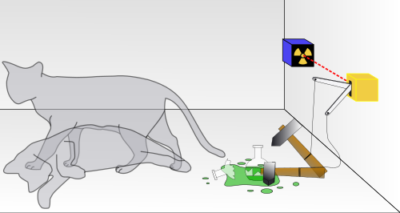
In Schrödinger's original formulation, a cat, a flask of poison, and a radioactive source are placed in a sealed box. If an internal radiation monitor such as a Geiger counter detects radioactivity (a single atom decaying), the flask is shattered, releasing the poison which kills the cat. If no decaying atom triggers the monitor, the cat remains alive. Mathematically, the wave function that describes the contents of the box is a combination, or quantum superposition, of these two possibilities. Yet, when one looks in the box, one sees the cat either alive or dead, not both alive and dead. This poses the question of when exactly quantum superposition ends and reality resolves into one possibility or the other.
Although originally a critique of Bohr and Heisenberg, Schrödinger's seemingly paradoxical thought experiment became part of the foundation of quantum mechanics. It is often featured in theoretical discussions of the interpretations of quantum mechanics, particularly in situations involving the measurement problem. As a result, Schrödinger's cat has had enduring appeal in popular culture. The experiment is not intended to be actually performed on a cat, but rather as an easily understandable illustration of the behavior of atoms. Experiments at the atomic scale have been carried out, showing that very small objects may exist as superpositions, but superposing an object as large as a cat would pose considerable technical difficulties.
Fundamentally, the Schrödinger's cat experiment asks how long quantum superpositions last and when (or whether) they collapse. Different interpretations of the mathematics of quantum mechanics have been proposed that give different explanations for this process.
From the Wikipedia article “Schrödinger's cat” (en.wikipedia.org/wiki/Schrödinger's_cat), by its contributors, under CC BY-SA 4.0 (creativecommons.org/licenses/by-sa/4.0/). Copied 2026-11-17; not changed.
Confirmed Two sources agree. Cited One source, and it names where it got it. One source One source, without a reference of its own. Sources disagree The sources disagree. We show the best-supported value and keep theirs below.
Picture: Dhatfield, via Wikimedia Commons · CC BY-SA 3.0