
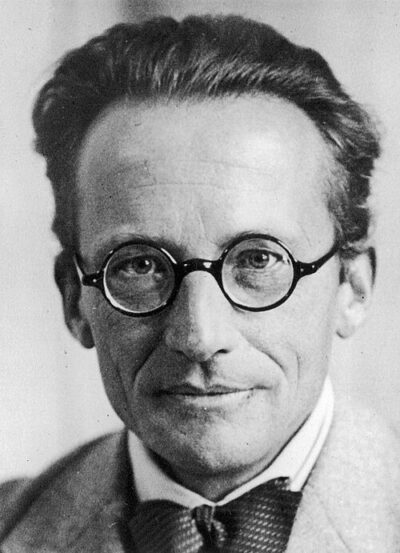
Erwin Schrödinger
Erwin Schrödinger was an Austrian physicist. Born August 12, 1887, in Vienna. Died January 4, 1961, in Vienna. Known for Schrödinger equation and Schrödinger's cat. Educated at University of Vienna and Akademisches Gymnasium. Awards include Matteucci Medal, Max Planck Medal and Nobel Prize in Physics.
Facts
56 facts · 2 confirmed by two sources · 8 cited · 46 from one source
Where this comes from
Papalocal keeps its own record. It started from these sources; what each one said is kept here as it was copied, so a change on their side never changes this page by itself. Tap one to read its version.
What Wikidata says · copied November 16, 2026 · revision 2568766966
- Described as
- Austrian physicist (1887–1961)
- Other names
- Erwin Rudolf Josef Alexander Schröndinger, Erwin Schrodinger, Schrödinger, Erwin Schroedinger, Schrodinger, Ervinus Rudolphus Iosephus Alexandrus Schrödinger
- Born
- August 12, 1887 · 13 references
- Died
- January 4, 1961 · 12 references
- Born in
- Vienna · 2 references
- Died in
- Vienna · 3 references
- Buried in
- Alpbach
- Cause of death
- tuberculosis
- Name at birth
- Erwin Rudolf Josef Alexander Schrödinger
- Citizen of
- Cisleithania; Germany; Nazi Germany; Austria
- Occupation
- physicist · 1 reference; theoretical physicist; non-fiction writer; mathematician; university teacher · 1 reference
- Worked for
- University of Vienna; University of Stuttgart; University of Jena; University of Zurich; University of Graz; Frederick William University Berlin; University of Wrocław; Humboldt-Universität zu Berlin
- Education
- University of Vienna · 1 reference; Akademisches Gymnasium
- Member of
- Royal Society of London; German Academy of Sciences at Berlin; Bavarian Academy of Sciences and Humanities; Academy of Sciences of the USSR; Pontifical Academy of Sciences · 1 reference; Austrian Academy of Sciences; American Academy of Arts and Sciences; Russian Academy of Sciences; Royal Prussian Academy of Sciences; Accademia Nazionale delle Scienze detta dei XL
- Known for
- Schrödinger equation; Schrödinger's cat
- Awards
- Matteucci Medal (1927); Max Planck Medal (1937); Nobel Prize in Physics (1933) · 2 references; Erwin Schrödinger Prize (1956); Pour le Mérite for Sciences and Arts order; Haitinger Prize (1920) · 1 reference; Fellow of the American Physical Society; Austrian Decoration for Science and Art (1957); Prize of the City of Vienna for Natural Sciences (1956); Foreign Member of the Royal Society (1949) · 1 reference; Pour le Mérite · 1 reference
- Field
- theoretical physics
- Spouse
- Annemarie Schrödinger
- Children
- Ruth Braunizer
- Father
- Rudolf Schrödinger
- Religion
- atheism · 1 reference
- Lived in
- Dublin (2 times) (1940–); Vienna (1956–)
- Wikipedias with a page
- 165
Wikidata item Q9130 (wikidata.org/wiki/Q9130), public domain (CC0). Copied November 16, 2026.
What Wikipedia says · copied November 16, 2026 · revision 1384478894
Erwin Rudolf Josef Alexander Schrödinger (12 August 1887 – 4 January 1961) was an Austrian theoretical physicist who developed fundamental results in quantum theory. In particular, he is recognized for devising the Schrödinger equation, an equation that provides a way to calculate the wave function of a system and how it changes dynamically in time. He coined the term "quantum entanglement" in 1935. Schrödinger shared the 1933 Nobel Prize in Physics with Paul Dirac "for the discovery of new productive forms of atomic theory".
In addition, Schrödinger wrote many works on various aspects of physics: statistical mechanics and thermodynamics, physics of dielectrics, color theory, electrodynamics, general relativity, and cosmology, and he made several attempts to construct a unified field theory. In his book, What Is Life?, Schrödinger addressed the problems of genetics, looking at the phenomenon of life from the point of view of physics. He also paid great attention to the philosophical aspects of science, ancient and oriental philosophical concepts, ethics, and religion. He also wrote on philosophy and theoretical biology. In popular culture, he is best known for "Schrödinger's cat", a thought experiment. He and Dirac tied for eighth in a Physics World poll of the greatest physicists of all time.
In his personal life, he lived with both his wife and his mistress which may have led to problems causing him to leave his position at Oxford. Subsequently, until 1938, he had a position in Graz, Austria, until the Nazi takeover when he fled, finally finding a long-term arrangement in Dublin, Ireland, where he remained until retirement in 1955. He returned to Vienna in 1956, with an emeritus professor position, and died of tuberculosis in 1961. In 1989, allegations of sexual abuse of several minors emerged. In 2026, a defence was published challenging some of these allegations.
- Born, in its opening lines
- August 12, 1887
- Died, in its opening lines
- January 4, 1961
From the Wikipedia article “Erwin Schrödinger” (en.wikipedia.org/wiki/Erwin_Schrödinger), by its contributors, under CC BY-SA 4.0 (creativecommons.org/licenses/by-sa/4.0/). Copied November 16, 2026; not changed.
Confirmed Two sources agree. Cited One source, and it names where it got it. One source One source, without a reference of its own. Sources disagree The sources disagree. We show the best-supported value and keep theirs below.
