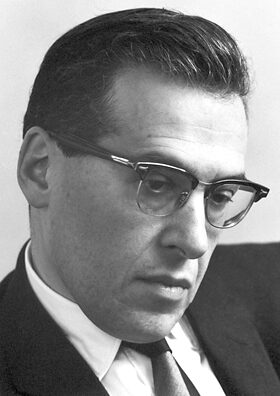
Schwinger boson
Schwinger boson is a representation of spin operators using second quantized boson operators.
All 3 facts, and where they come from
Facts
3 facts · 0 confirmed by two sources · 0 cited · 3 from one source
Where this comes from
Papalocal keeps its own record. It started from these sources; what each one said is kept here as it was copied, so a change on their side never changes this page by itself. Tap one to read its version.
What Wikidata says · copied November 16, 2026 · revision 2527290960
- Described as
- representation of spin operators using second quantized boson operators
- What it is
- quantum particle; physical theory
- Named after
- Julian Seymour Schwinger
- Wikipedias with a page
- 2
Wikidata item Q110905030 (wikidata.org/wiki/Q110905030), public domain (CC0). Copied 2026-11-16.
What Wikipedia says · copied November 16, 2026 · revision 1367723787
In quantum mechanics, the Schwinger boson representation maps quantum spin to bosonic fields. The theory was introduced by Julian Schwinger in 1952. The method is a special case for the more general Jordan–Schwinger map.
As opposed to the Holstein–Primakoff transformation, which only uses a single bosonic field the Schwinger boson theory uses two. The advantage of this representation is that the complicated square root terms of the Holstein–Primakoff transformation are avoided.
The Schwinger boson representation is often used to treat ferromagnetic, antiferromagnetic and frustrated spin systems in equilibrium and non-equilibrium conditions The representation is also used to describe states of atomic ensembles in quantum optics.
From the Wikipedia article “Schwinger boson representation” (en.wikipedia.org/wiki/Schwinger_boson_representation), by its contributors, under CC BY-SA 4.0 (creativecommons.org/licenses/by-sa/4.0/). Copied 2026-11-16; not changed.
Confirmed Two sources agree. Cited One source, and it names where it got it. One source One source, without a reference of its own. Sources disagree The sources disagree. We show the best-supported value and keep theirs below.