
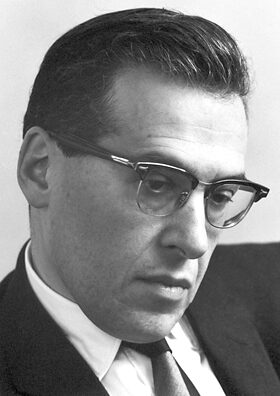
Julian Seymour Schwinger
Julian Seymour Schwinger was an American theoretical physicist. Born February 12, 1918, in New York City. Died July 16, 1994, in Los Angeles. Known for Rarita–Schwinger equation, Lippmann–Schwinger equation and Schwinger model. Educated at Columbia University and City College of New York. Awards include Albert Einstein Award, Josiah Willard Gibbs Lectureship and National Medal of Science.
Facts
44 facts · 2 confirmed by two sources · 12 cited · 30 from one source
Where this comes from
Papalocal keeps its own record. It started from these sources; what each one said is kept here as it was copied, so a change on their side never changes this page by itself. Tap one to read its version.
What Wikidata says · copied November 13, 2026 · revision 2567390234
- Described as
- American theoretical physicist (1918–1994)
- Other names
- Julian Schwinger
- Born
- February 12, 1918 · 9 references
- Died
- July 16, 1994 · 8 references
- Born in
- New York City · 1 reference
- Died in
- Los Angeles · 1 reference
- Buried in
- Mount Auburn Cemetery · 2 references
- Cause of death
- pancreatic cancer
- Citizen of
- United States
- Occupation
- university teacher; non-fiction writer; mathematician; theoretical physicist; nuclear physicist; physicist · 2 references
- Worked for
- University of California, Los Angeles; Harvard University; Purdue University; University of California, Berkeley (1939); Massachusetts Institute of Technology (1941)
- Education
- Columbia University (–1939) · 1 reference; City College of New York; Townsend Harris High School · 1 reference
- Member of
- American Academy of Arts and Sciences; American Association for the Advancement of Science · 1 reference; American Physical Society · 1 reference; National Academy of Sciences
- Known for
- Rarita–Schwinger equation; Lippmann–Schwinger equation; Schwinger model; Schwinger boson; Schwinger–Dyson equation; Schwinger effect; Schwinger limit; Schwinger parametrization; Schwinger variational principle; KMS state
- Awards
- Albert Einstein Award (1951) · 1 reference; Josiah Willard Gibbs Lectureship (1960) · 1 reference; National Medal of Science (1964) · 1 reference; Nobel Prize in Physics (1965) · 2 references; Guggenheim Fellowship (1970) · 1 reference; doctor honoris causa from the Pierre and Marie Curie University (1990) · 2 references; Fellow of the American Physical Society; Humboldt Prize
- Field
- quantum electrodynamics · 1 reference
- Wikipedias with a page
- 74
Wikidata item Q186465 (wikidata.org/wiki/Q186465), public domain (CC0). Copied November 13, 2026.
What Wikipedia says · copied November 13, 2026 · revision 1374788546
Julian Seymour Schwinger (; February 12, 1918 – July 16, 1994) was an American theoretical physicist. He shared the 1965 Nobel Prize in Physics with Richard Feynman and Shin'ichirō Tomonaga "for their fundamental work in quantum electrodynamics (QED), with deep-ploughing consequences for the physics of elementary particles". He developed a relativistically invariant perturbation theory, and renormalized QED to one loop order. Schwinger was a physics professor at several universities.
Schwinger is recognized as an important physicist, responsible for much of modern quantum field theory, including a variational approach, and the equations of motion for quantum fields. He developed the first electroweak model, and the first example of confinement in 1+1 dimensions. He is responsible for the theory of multiple neutrinos, Schwinger terms, and the theory of the spin-3/2 field. He shared the inaugural Albert Einstein Award with Kurt Gödel.
- Born, in its opening lines
- February 12, 1918
- Died, in its opening lines
- July 16, 1994
From the Wikipedia article “Julian Schwinger” (en.wikipedia.org/wiki/Julian_Schwinger), by its contributors, under CC BY-SA 4.0 (creativecommons.org/licenses/by-sa/4.0/). Copied November 13, 2026; not changed.
Confirmed Two sources agree. Cited One source, and it names where it got it. One source One source, without a reference of its own. Sources disagree The sources disagree. We show the best-supported value and keep theirs below.
