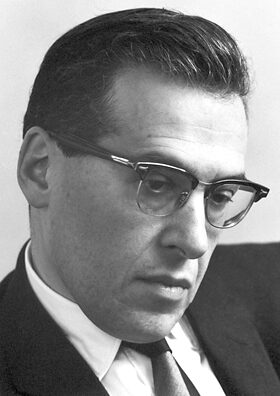
Schwinger model
Schwinger model is a quantum electrodynamics in 1+1 dimensions.
All 2 facts, and where they come from
Facts
2 facts · 0 confirmed by two sources · 0 cited · 2 from one source
Where this comes from
Papalocal keeps its own record. It started from these sources; what each one said is kept here as it was copied, so a change on their side never changes this page by itself. Tap one to read its version.
What Wikidata says · copied November 16, 2026 · revision 2072642551
- Described as
- quantum electrodynamics in 1+1 dimensions
- What it is
- physical theory
- Named after
- Julian Seymour Schwinger
- Wikipedias with a page
- 5
Wikidata item Q3318083 (wikidata.org/wiki/Q3318083), public domain (CC0). Copied 2026-11-16.
What Wikipedia says · copied November 16, 2026 · revision 1354783414
In quantum field theory, the Schwinger model is a model describing 1+1D (time + 1 spatial dimension) quantum electrodynamics (QED) which includes electrons, coupled to photons. It is named after Julian Schwinger who developed it in 1962.
The model defines the usual QED Lagrangian densityℒ=−14g2FμνFμν+ψ¯(iγμDμ−m)ψ
over a spacetime with one spatial dimension and one temporal dimension. Where Fμν=∂μAν−∂νAμ is the photon field strength with symmetry group U(1) (unitary group), Dμ=∂μ−iAμ is the gauge covariant derivative, ψ is the fermion spinor, m is the fermion mass and γ0,γ1 form the two-dimensional representation of the Clifford algebra.
This model exhibits confinement of the fermions and as such, is a toy model for quantum chromodynamics. A handwaving argument why this is so is because in two dimensions, classically, the potential between two charged particles goes linearly as r, instead of 1/r in 4 dimensions, 3 spatial, 1 time. This model also exhibits a spontaneous symmetry breaking of the U(1) symmetry due to a chiral condensate due to a pool of instantons. The photon in this model becomes a massive particle at low temperatures. This model can be solved exactly and is used as a toy model for other more complex theories.
From the Wikipedia article “Schwinger model” (en.wikipedia.org/wiki/Schwinger_model), by its contributors, under CC BY-SA 4.0 (creativecommons.org/licenses/by-sa/4.0/). Copied 2026-11-16; not changed.
Confirmed Two sources agree. Cited One source, and it names where it got it. One source One source, without a reference of its own. Sources disagree The sources disagree. We show the best-supported value and keep theirs below.