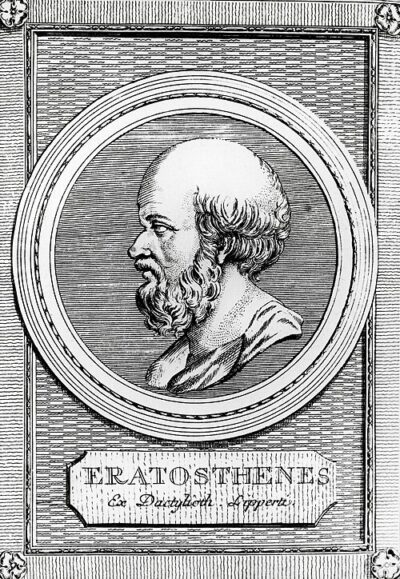
sieve of Eratosthenes
Sieve of Eratosthenes is an ancient algorithm for generating prime numbers.
All 3 facts, and where they come from
Facts
3 facts · 0 confirmed by two sources · 0 cited · 3 from one source
Where this comes from
Papalocal keeps its own record. It started from these sources; what each one said is kept here as it was copied, so a change on their side never changes this page by itself. Tap one to read its version.
What Wikidata says · copied November 17, 2026 · revision 2553129610
- Described as
- ancient algorithm for generating prime numbers
- What it is
- primality test; sieve
- Named after
- Eratosthenes
- Wikipedias with a page
- 67
Wikidata item Q177898 (wikidata.org/wiki/Q177898), public domain (CC0). Copied 2026-11-17.
What Wikipedia says · copied November 17, 2026 · revision 1378696777
In mathematics, the sieve of Eratosthenes is an ancient algorithm for finding all prime numbers up to any given limit.
It does so by iteratively marking as composite (i.e., not prime) the multiples of each prime, starting with the first prime number, 2. The multiples of a given prime are generated as a sequence of numbers starting from that prime, with constant difference between them that is equal to that prime. This is the sieve's key distinction from using trial division to sequentially test each candidate number for divisibility by each prime. Once all the multiples of each discovered prime have been marked as composites, the remaining unmarked numbers are primes.
The earliest known reference to the sieve (Ancient Greek: κόσκινον Ἐρατοσθένους, kóskinon Eratosthénous) is in Nicomachus of Gerasa's Introduction to Arithmetic, an early 2nd-century CE book which attributes it to Eratosthenes of Cyrene, a 3rd-century BCE Greek mathematician, though describing the sieving by odd numbers instead of by primes.
One of several prime number sieves, it is one of the most efficient ways to find all of the smaller primes. It may be used to find primes in arithmetic progressions.
From the Wikipedia article “Sieve of Eratosthenes” (en.wikipedia.org/wiki/Sieve_of_Eratosthenes), by its contributors, under CC BY-SA 4.0 (creativecommons.org/licenses/by-sa/4.0/). Copied 2026-11-17; not changed.
Confirmed Two sources agree. Cited One source, and it names where it got it. One source One source, without a reference of its own. Sources disagree The sources disagree. We show the best-supported value and keep theirs below.