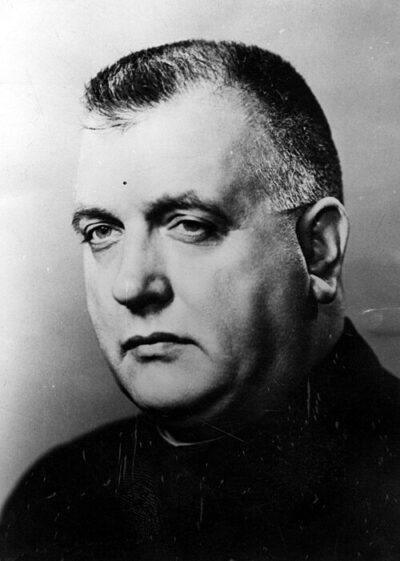
Slovak People's Party
The Slovak People's Party is a political party. It was founded in 1913 by Andrej Hlinka. It stands for Slovak nationalism, corporate statism and clerical fascism.
- Country
- Slovakia
- Founded
- July 29, 1913
- Ideology
- Slovak nationalism
All 13 facts, and where they come from
Facts
13 facts · 0 confirmed by two sources · 1 cited · 12 from one source
Where this comes from
Papalocal keeps its own record. It started from these sources; what each one said is kept here as it was copied, so a change on their side never changes this page by itself. Tap one to read its version.
What Wikidata says · copied November 17, 2026 · revision 2570414807
- Described as
- political party
- Other names
- Slovak People's Party – Party of Slovak National Unity, Slowakische Hlinka-Volkspartei – Partei der Slowakischen Nationalen Einheit, Hlinkas Slowakische Volkspartei – Partei der Slowakischen Nationalen Einheit
- What it is
- political party
- Country of origin
- Slovak Republic; Czechoslovakia
- Founded
- July 29, 1913
- Ended
- May 1945 · 1 reference
- Founded by
- Andrej Hlinka
- Country
- Slovakia · 1 reference
- Chair
- Andrej Hlinka (1913–1938); Jozef Tiso (1939–1945)
- Ideology
- Slovak nationalism · 1 reference; corporate statism; clerical fascism; anti-Hungarian sentiment
- Wikipedias with a page
- 23
Wikidata item Q693985 (wikidata.org/wiki/Q693985), public domain (CC0). Copied 2026-11-17.
What Wikipedia says · copied November 17, 2026 · revision 1384976350
Hlinka's Slovak People's Party (Slovak: Hlinkova slovenská ľudová strana), also known as the Slovak People's Party (Slovenská ľudová strana, SĽS) or the Hlinka Party, was a far-right clerico-fascist political party with a strong Catholic fundamentalist and authoritarian ideology. Its members were often called ľudáci (Ľudáks, singular: ľudák).
The party arose at a time when Slovakia was still part of Austria-Hungary and fought for democratic liberties, the independence and sovereignty of Slovakia, and against the influence of liberalism. After the formation of Czechoslovakia, the party preserved its conservative ideology, opposing Czechoslovakism and demanding Slovak autonomy. In the second half of the 1930s, the rise of totalitarian regimes in Europe and the party's inability to achieve long-term political objectives caused a loss of the party's faith in democratic procedures and saw the party turn towards more radical and extremist ideologies such as fascism.
After a merger with other parties in November 1938, which formed the Hlinka's Slovak People's Party – Party of Slovak National Unity, it became the dominant party of the Slovak Republic. In addition to adopting a totalitarian vision of the state, it included an openly pro-Nazi faction, which dominated Slovak policy between 1940 and 1942. The party's chairmen were the Slovak priests Andrej Hlinka (1913–1938) and later Jozef Tiso (1939–1945), and its main newspapers were the Slovenské ľudové noviny (Slovak People's News, 1910–1930), Slovák (Slovak, 1919–1945) and Slovenská pravda (Slovak Truth, 1936–1945).
From the Wikipedia article “Slovak People's Party” (en.wikipedia.org/wiki/Slovak_People's_Party), by its contributors, under CC BY-SA 4.0 (creativecommons.org/licenses/by-sa/4.0/). Copied 2026-11-17; not changed.
Confirmed Two sources agree. Cited One source, and it names where it got it. One source One source, without a reference of its own. Sources disagree The sources disagree. We show the best-supported value and keep theirs below.