
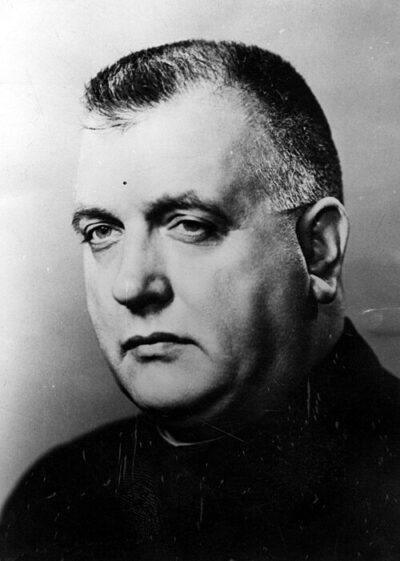
Jozef Tiso
Jozef Tiso was a Slovak politician, priest and president of the Slovak Republic from 1939 to 1945. Born October 13, 1887, in Bytča. Died April 18, 1947, in Bratislava. Positions held include President of Slovakia (1939–1945). Educated at University of Vienna. Awards include Order of the German Eagle.
Facts
21 facts · 2 confirmed by two sources · 10 cited · 9 from one source
Where this comes from
Papalocal keeps its own record. It started from these sources; what each one said is kept here as it was copied, so a change on their side never changes this page by itself. Tap one to read its version.
What Wikidata says · copied November 16, 2026 · revision 2558039296
- Described as
- Slovak politician, priest and president of the Slovak Republic from 1939 to 1945
- Other names
- Josef Tiso, Joseph Tiso, Father Tiso
- Born
- October 13, 1887 · 9 references
- Died
- April 18, 1947 · 11 references
- Born in
- Bytča · 1 reference
- Died in
- Bratislava · 2 references
- Buried in
- St. Emmeram's Cathedral, Nitra (2008–) · 1 reference
- Cause of death
- hanging to death
- Citizen of
- Slovak Republic; Czechoslovakia; Hungary (–1918)
- Occupation
- politician · 1 reference; Catholic priest · 1 reference; military officer · 1 reference; essayist · 1 reference; diarist · 1 reference; teacher · 1 reference
- Positions held
- President of Slovakia (1939–1945)
- Political party
- Slovak People's Party
- Education
- University of Vienna
- Awards
- Order of the German Eagle · 1 reference
- Field
- politics · 1 reference
- Religion
- Catholic Church
- Wikipedias with a page
- 57
Wikidata item Q154346 (wikidata.org/wiki/Q154346), public domain (CC0). Copied November 16, 2026.
What Wikipedia says · copied November 16, 2026 · revision 1385635284
Jozef Gašpar Tiso (Slovak pronunciation: [ˈjɔzef ˈtisɔ], Hungarian pronunciation: [ˈjoʒɛf ˈtiso]; 13 October 1887 – 18 April 1947) was a Slovak politician and Catholic priest who served as president of the First Slovak Republic, a client state of Nazi Germany during World War II, from 1939 to 1945. He previously served as Prime Minister of the Autonomous Land of Slovakia from October 1938 to March 1939, where he then served as Prime Minister of the Slovak Republic until October 1939. After the war, in 1947, he was convicted of treason and executed in Bratislava.
Born in 1887 to Slovak parents in Nagybiccse (today Bytča), then part of Hungary, Austria-Hungary, Tiso studied several languages during his school career, including Hebrew and German. He was introduced to priesthood from an early age, and helped combat local poverty and alcoholism in what is now Slovakia. He joined the Slovak People's Party (Slovenská ľudová strana) in 1918 and became party leader in 1938 following the death of Andrej Hlinka. On 14 March 1939, the Slovak Assembly in Bratislava unanimously adopted Law 1/1939 transforming the autonomous Slovak Republic (that was until then part of Czechoslovakia) into an independent country. Two days after Nazi Germany seized the remainder of the Czech Lands, the Protectorate of Bohemia and Moravia was proclaimed.
Tiso, who was already the prime minister of autonomous Slovakia (under Czechoslovak law), became the Slovak Republic's prime minister, and, in October 1939, was elected its president. Tiso collaborated with Germany in deporting Jews, sending many Slovak Jews to extermination and concentration camps in Germany and German-occupied Poland, while some Jews in Slovakia were murdered outright. Deportations were carried out from 25 March 1942 until 20 October 1942, after the Vatican and other Catholic officials had been repeatedly denouncing and protesting the deportations. An anti-fascist partisan insurgency was waged, culminating in the Slovak National Uprising in summer 1944. After German military authorities suppressed the uprising and executed many of its leaders, Slovakia was largely occupied by Germany. Consequently, when the deportations of Jews were renewed on 30 September 1944, an additional 13,500 were deported, despite renewed Vatican condemnations.
When the Soviet Red Army overran the last parts of western Slovakia in April 1945, Tiso fled to Austria and then Germany, where American troops arrested him and then had him extradited back to the restored Czechoslovakia, where he was convicted of high treason, betrayal of the national uprising, and collaboration with the Nazis, and then executed by hanging in 1947 and buried in Bratislava. In 2008, his remains were buried in the canonical crypt of the Cathedral in Nitra, Slovakia.
- Born, in its opening lines
- October 13, 1887
- Died, in its opening lines
- April 18, 1947
From the Wikipedia article “Jozef Tiso” (en.wikipedia.org/wiki/Jozef_Tiso), by its contributors, under CC BY-SA 4.0 (creativecommons.org/licenses/by-sa/4.0/). Copied November 16, 2026; not changed.
Confirmed Two sources agree. Cited One source, and it names where it got it. One source One source, without a reference of its own. Sources disagree The sources disagree. We show the best-supported value and keep theirs below.
