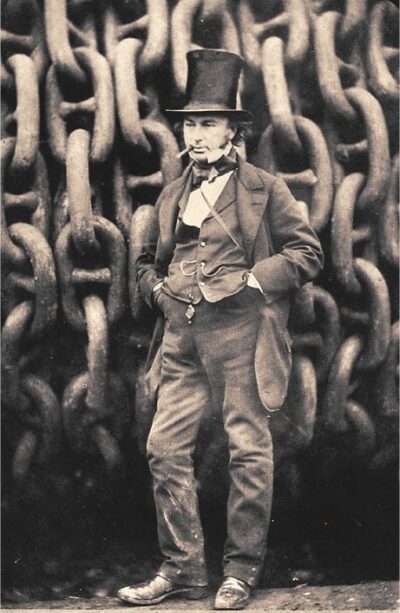
SS Great Eastern
SS Great Eastern is a British sailing steamship.
All 2 facts, and where they come from
Facts
2 facts · 0 confirmed by two sources · 0 cited · 2 from one source
Where this comes from
Papalocal keeps its own record. It started from these sources; what each one said is kept here as it was copied, so a change on their side never changes this page by itself. Tap one to read its version.
What Wikidata says · copied November 17, 2026 · revision 2517496083
- Described as
- British sailing steamship
- Other names
- Great Eastern
- What it is
- steamship; encyclopedia article
- Wikipedias with a page
- 35
Wikidata item Q733293 (wikidata.org/wiki/Q733293), public domain (CC0). Copied 2026-11-17.
What Wikipedia says · copied November 17, 2026 · revision 1377756816
SS Great Eastern was an iron-hulled steamship designed by Isambard Kingdom Brunel, and built by John Scott Russell & Co. at Millwall Iron Works on the River Thames, London, England. Powered by both sidewheels and a screw propeller, she was by far the largest ship ever built at the time of her 1858 launch, and had the capacity to carry 4,000 passengers from England to Australia without refuelling. Her length of 692 feet (211 m) was surpassed only in 1899, by the 705-foot (215 m) 17,274-gross-ton RMS Oceanic, her gross tonnage of 18,915 was surpassed only in 1901, by the 701-foot (214 m) 20,904-gross-ton RMS Celtic and her 4,000-passenger capacity was surpassed only in 1913, by the 4,234-passenger SS Imperator. Her five funnels (later reduced to four) was unusual for the time. She also had the largest set of paddle wheels in existence.
Brunel knew her affectionately as the "Great Babe". He died in 1859 shortly after her maiden voyage, during which she was damaged by an explosion. After repairs, she plied for several years in her intended use as a passenger liner between Britain and North America, her voyages made largely unprofitable by her high initial and operating costs. Within a few years she was repurposed to lay underwater cable, laying the first lasting transatlantic telegraph cable in 1866. Finishing her life as a floating music hall and advertising hoarding (for the department store Lewis's) in Liverpool, she was broken up on Merseyside in 1889.
From the Wikipedia article “SS Great Eastern” (en.wikipedia.org/wiki/SS_Great_Eastern), by its contributors, under CC BY-SA 4.0 (creativecommons.org/licenses/by-sa/4.0/). Copied 2026-11-17; not changed.
Confirmed Two sources agree. Cited One source, and it names where it got it. One source One source, without a reference of its own. Sources disagree The sources disagree. We show the best-supported value and keep theirs below.
Picture: Wikimedia Commons: Great Eastern 1866-crop.jpg · See Commons file page