
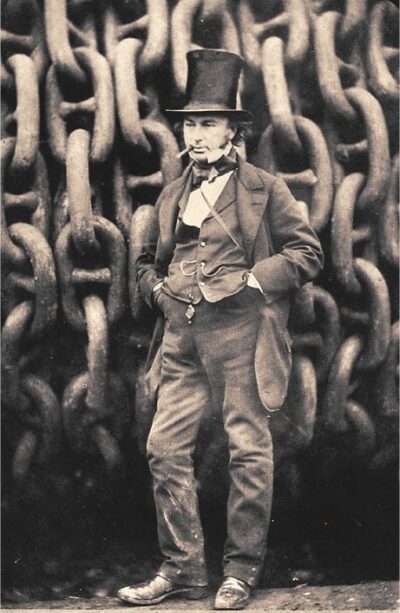
Isambard Kingdom Brunel
Isambard Kingdom Brunel was a British mechanical and civil engineer. Born April 9, 1806, in Portsmouth. Died September 15, 1859, in Westminster. Known for Royal Albert Bridge, Clifton Suspension Bridge and Great Western Railway. Educated at University of Caen Normandy and Lycée Henri-IV. Awards include Fellow of the Royal Society.
Facts
31 facts · 2 confirmed by two sources · 17 cited · 12 from one source
Where this comes from
Papalocal keeps its own record. It started from these sources; what each one said is kept here as it was copied, so a change on their side never changes this page by itself. Tap one to read its version.
What Wikidata says · copied November 16, 2026 · revision 2567536506
- Described as
- British mechanical and civil engineer (1806–1859)
- Other names
- Brunel, I.K. Brunel
- Born
- April 9, 1806 · 12 references
- Died
- September 15, 1859 · 9 references
- Born in
- Portsmouth · 1 reference
- Died in
- Westminster · 1 reference
- Buried in
- Kensal Green Cemetery · 2 references
- Cause of death
- stroke
- Citizen of
- United Kingdom of Great Britain and Ireland
- Occupation
- civil engineer · 1 reference; mechanical engineer · 1 reference; architect · 2 references; engineer · 1 reference; railway engineer · 1 reference
- Education
- University of Caen Normandy; Lycée Henri-IV
- Member of
- Royal Society of London (1830–); Institution of Civil Engineers
- Known for
- Royal Albert Bridge; Clifton Suspension Bridge; Great Western Railway; SS Great Britain; SS Great Eastern; SS Great Western
- Awards
- Fellow of the Royal Society (1830) · 1 reference
- Spouse
- Mary Elizabeth Horsley · 1 reference
- Children
- Henry Marc Brunel · 1 reference; Isambard Brunel · 2 references; Florence Mary Brunel · 2 references
- Father
- Marc Isambard Brunel · 1 reference
- Mother
- Sophia Kingdom · 1 reference
- Siblings
- Emma Joan Brunel · 1 reference; Sophia Macnamara Brunel · 1 reference
- Wikipedias with a page
- 55
Wikidata item Q207380 (wikidata.org/wiki/Q207380), public domain (CC0). Copied November 16, 2026.
What Wikipedia says · copied November 16, 2026 · revision 1384368616
Isambard Kingdom Brunel (9 April 1806 – 15 September 1859) was an English civil and marine engineer considered "one of the greatest figures of the Industrial Revolution", "perhaps the most eminent Victorian engineer", and one whose work "altered the lives of almost every person in Britain, and millions abroad". The first engineer of the Great Western Railway (GWR), he was responsible for the design and construction of its London–Bristol main line. His maritime career saw the construction of the largest steamships in the world at the time, the SS Great Western, SS Great Britain, and SS Great Eastern. His career was marred by continual financial and engineering setbacks.
His first major project, the Thames Tunnel, was cancelled after a collapse nearly killed him, and was only completed later without his involvement. While recovering, he began his work on the Clifton Suspension Bridge; after riots in Bristol around government policy, work on the bridge was cancelled and it was only completed after his death.
Brunel's time at the GWR saw ground-breaking advances in railway design and construction quality, yet was marred by frequent conflict with its board and figures such as Dionysius Lardner. Additionally, his choice to use a broad gauge of 7 ft 1⁄4 in (2,140 mm) became greatly problematic for the GWR in the long-term, and his attempt to convert parts of the network into an atmospheric railway was unsuccessful. His railway career involved his founding of many of the principles of a successful railway, with his route for the Great Western Main Line minimising curves and gradients. Brunel's construction of the Box Tunnel, the longest in the world at the time, was a success in spite of claims it would be impossible to construct safely. The Royal Albert Bridge was also eventually successful, but the lasting impact of the panic of 1847 meant Brunel had to simplify its design, and it was only completed shortly before his death.
Seeking to expand the GWR westwards toward the Americas, Brunel began looking at the prospect of developing steamships in the mid-1830s, and the three ships he built were each engineering marvels in their own right. The SS Great Western was the second ship to hold the Blue Riband, and her transatlantic crossings were commercially successful. The SS Great Britain was both the first iron-hulled and propeller-driven ship to make a transatlantic crossing, and was successful until her running aground in 1847 bankrupted her parent company. The SS Great Eastern was set back by conflict between Brunel and John Scott Russell and marred by financial and technical problems, with Brunel dying shortly after she suffered a huge explosion on her maiden voyage. She never saw commercial success except as a cable layer.
In 2002, Brunel was placed second in a BBC public poll to determine the "100 Greatest Britons", with a major programme of events celebrating the 200th anniversary of his birth in 2006. Brunel is remembered as an engineering genius and visionary, whose maritime works in particular were too far ahead of their time to see success. His obituary in the Morning Chronicle remarked that "the history of invention records no instance of grand novelties so boldly imagined and so successfully carried out by the same individual".
- Born, in its opening lines
- April 9, 1806
- Died, in its opening lines
- September 15, 1859
From the Wikipedia article “Isambard Kingdom Brunel” (en.wikipedia.org/wiki/Isambard_Kingdom_Brunel), by its contributors, under CC BY-SA 4.0 (creativecommons.org/licenses/by-sa/4.0/). Copied November 16, 2026; not changed.
Confirmed Two sources agree. Cited One source, and it names where it got it. One source One source, without a reference of its own. Sources disagree The sources disagree. We show the best-supported value and keep theirs below.
