
State Elder
State Elder is a Head of State of Estonia, 1920-1937.
All 4 facts, and where they come from
Facts
4 facts · 0 confirmed by two sources · 0 cited · 4 from one source
Where this comes from
Papalocal keeps its own record. It started from these sources; what each one said is kept here as it was copied, so a change on their side never changes this page by itself. Tap one to read its version.
What Wikidata says · copied November 17, 2026 · revision 2568900019
- Described as
- Head of State of Estonia, 1920-1937
- Other names
- Head of State of Estonia
- What it is
- position
- Created
- December 20, 1920
- Country
- Estonia
- Office of
- Estonia
- Wikipedias with a page
- 19
Wikidata item Q493018 (wikidata.org/wiki/Q493018), public domain (CC0). Copied 2026-11-17.
What Wikipedia says · copied November 17, 2026 · revision 1379158288
The State Elder (Estonian: riigivanem), sometimes also translated as Head of State, was the official title of the Estonian head of state from 1920 to 1937. He combined some of the functions held by a president and prime minister in most other democracies.
According to the 1920 Estonian Constitution, which was enforced by the "Constitution of the Republic of Estonia, the Referendum Act and the Citizens’s Initiative Act Implementation Act" on July 2, 1920, after being approved by the Constituent Assembly on June 16, 1920 (Riigi Teataja August 9, 1920 No. 113/114), the Government of the Republic consisted of the riigivanem (State Elder) and Ministers (Section 58).
The responsibilities of the State Elder were representing the Republic of Estonia, administration and co-ordination of the activities of the Government of the Republic, chairing the Government meetings; the State Elder had the right to make inquiries about the activities of the Ministers (Section 62). The Government of the Republic appointed one of its members the Deputy of the Elder of State.
In practice, the State Elder had very little power. The 1920 constitution was radically parliamentarian in character, and the State Elder could be voted out of office at any time. This limited his ability to play a balancing role between the government and the legislature.
With the 1934 constitution, the institution saw a reform and it became the equivalent of a president only as a separate head of government was to be elected. The 1934 coup by Konstantin Päts resulted in the institution never coming to real life as he ruled as the Prime Minister in Duties of the State Elder until 1937.
From the Wikipedia article “State Elder of Estonia” (en.wikipedia.org/wiki/State_Elder_of_Estonia), by its contributors, under CC BY-SA 4.0 (creativecommons.org/licenses/by-sa/4.0/). Copied 2026-11-17; not changed.
Confirmed Two sources agree. Cited One source, and it names where it got it. One source One source, without a reference of its own. Sources disagree The sources disagree. We show the best-supported value and keep theirs below.
People connected 8
Held this office
 Kaarel Eenpalu (1932)Estonian politician (1888–1942)
 Otto Strandman (1929–1931)Estonian politician (1875–1941)
 Jaan Tõnisson (1927–1933)Estonian politician and lawyer (1868–1941)
 Jaan Teemant (1925–1932)Estonian lawyer and politician (1872–1940)
 Friedrich Akel (1924)Estonian diplomat and politician (1871–1941)
 Juhan Kukk (1922–1923)Estonian politician (1885-1942)
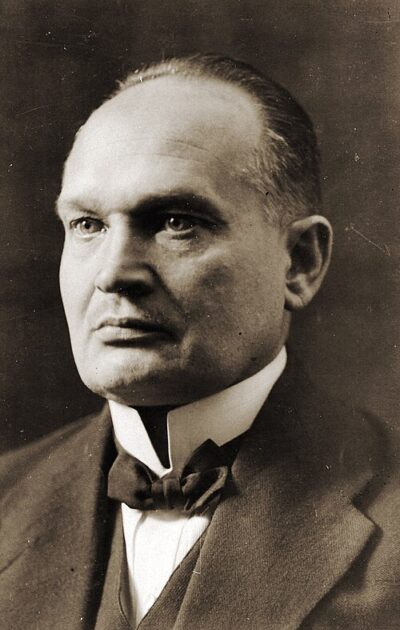 Konstantin Päts (1921–1934)Estonian politician (1874–1956)
 Ants Piip (1920–1921)Estonian politician, diplomat and legal scholar (1884–1942)
