
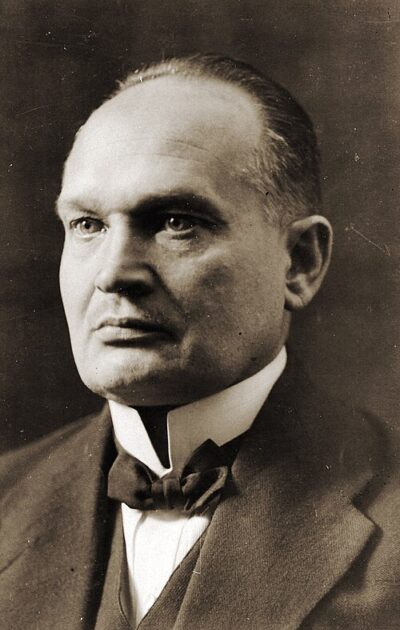
Konstantin Päts
Konstantin Päts was an Estonian politician. Born February 22, 1874, in Tahkuranna. Died January 18, 1956, in Burashevo. Positions held include President of Estonia (1938–1940), Minister of the Interior (1918) and State Elder (2 times) (1921–1934). Educated at Imperial University of Dorpat. Awards include Order of the White Eagle, Order of the Three Stars, 1st Class and Collar of the Order of the National Coat of Arms.
Facts
50 facts · 1 confirmed by two sources · 18 cited · 30 from one source · 1 where the sources disagree
What’s different
- Born: we show February 22, 1874 (Sources disagree). Wikipedia says February 23, 1874
Where this comes from
Papalocal keeps its own record. It started from these sources; what each one said is kept here as it was copied, so a change on their side never changes this page by itself. Tap one to read its version.
What Wikidata says · copied November 16, 2026 · revision 2565555718
- Described as
- Estonian politician (1874–1956)
- Born
- February 22, 1874 · 1 reference
- Died
- January 18, 1956 · 9 references
- Born in
- Tahkuranna
- Died in
- Burashevo · 1 reference
- Buried in
- Metsakalmistu
- Citizen of
- Russian Empire; Estonia
- Occupation
- politician · 1 reference; journalist; lawyer; jurist · 2 references; sportsperson; head of government · 1 reference; head of state · 1 reference; author · 1 reference
- Positions held
- President of Estonia (1938–1940); Minister of the Interior (1918); State Elder (2 times) (1921–1934) · 1 reference; Prime Minister in duties of the State Elder (1934–1937) · 1 reference; President-Regent (1937–1938) · 1 reference; Prime Minister of Estonia (1918–1919) · 1 reference; President of the Riigikogu (1922–1923) · 1 reference; member of the Estonian Constituent Assembly (1919–1920) · 1 reference
- Political party
- Farmers' Assemblies; Eesti Maarahva Liit · 1 reference
- Education
- Imperial University of Dorpat
- Member of
- Estonian Academy of Sciences
- Awards
- Order of the White Eagle; Order of the Three Stars, 1st Class; Collar of the Order of the National Coat of Arms (1938); Order of the White Star, Collar Class (1938); Grand Cross of the Legion of Honour; Cross of Liberty; 1st Class of the Order of the Cross of the Eagle; Estonian Red Cross Order First Class; Grand Cross of the Order of the Dannebrog (1933) · 1 reference; Knight Grand Cross of the Order of Saints Maurice and Lazarus; Order of Bishop Platon; Grand Cross of the Order of Polonia Restituta · 1 reference; honorary citizen of Tartu; Grand Cross of the Order of the White Rose of Finland (1922) · 1 reference; Grand Cross with Collar of the Order of the White Rose of Finland (1937) · 1 reference
- Field
- politics · 1 reference; law · 1 reference; insurance industry · 1 reference; economics of banking · 1 reference; opinion journalism · 1 reference
- Children
- Viktor Päts
- Siblings
- Voldemar Päts · 1 reference
- Religion
- Eastern Orthodox Church
- Wikipedias with a page
- 57
Wikidata item Q299114 (wikidata.org/wiki/Q299114), public domain (CC0). Copied November 16, 2026.
What Wikipedia says · copied November 16, 2026 · revision 1381450178
Konstantin Päts (23 February [O.S. 11 February] 1874 – 18 January 1956) was an Estonian statesman and the country's president from 1938 to 1940. Päts was one of the most influential politicians of the independent democratic Republic of Estonia, and during the two decades prior to World War II he also served five times as the country's State Elder. After the 16–17 June 1940 Soviet invasion and occupation of Estonia, Päts remained formally in office for over a month, until he was forced to resign, imprisoned by the new Stalinist regime, and deported to the USSR, where he died in 1956.
Päts was one of the first Estonians to become active in politics, and he then started a famous, nearly four-decade long, political rivalry with Jaan Tõnisson — first through journalism with his newspaper Teataja, later through politics. Although Päts was sentenced to death (in absentia) during the Russian Revolution of 1905, he was able to flee abroad, first to Switzerland, then to Finland, where he continued his literary work. He returned to Estonia (then part of the Russian Empire), and had to serve a prison sentence in 1910–1911.
After the February Revolution in 1917, Päts headed the provincial government of the newly formed Autonomous Governorate of Estonia, which was forced to go underground after the Bolshevik coup in November 1917. On 19 February 1918, Päts became one of the three members of the Estonian Salvation Committee that issued the Estonian Declaration of Independence on 24 February 1918. He headed the Estonian Provisional Government (1918–1919), although he was also imprisoned by the German occupation regime for several months in 1918. In the provisional government, Päts also served as Minister of Internal Affairs (1918) and Minister of War (1918–1919) that left him in charge of organizing the Estonian military in the War of Independence against the Soviet Russian invasion.
During the 1920s and early 1930s, Päts led one of the more prominent right-wing parties of the time – the conservative Farmers' Assemblies, which eventually merged into another party, the Union of Settlers and Smallholders in 1932. Päts was the Speaker of the Parliament (Riigikogu) (1922–1923) and served five times as State Elder, a post equivalent to that of president in Estonia's radically parliamentarian system (1921–1922, 1923–1924, 1931–1932, 1932–1933, and 1933–1934). During his last term as State Elder, he organized a self-coup to neutralise the right-wing populist Vaps Movement. He was supported by the army and the parliament. During the 1934–1938 "Era of Silence", many reforms were made and the economy grew, while he postponed the return of constitutional order. Largely supported by General Johan Laidoner, Commander of the Estonian Defence Forces, Päts ruled as Prime Minister in duties of the State Elder (1934–1937) and President-Regent (1937–1938) until a new constitution was adopted in 1938, after which Päts was elected the first President of Estonia. During his presidency, the Stalinist Soviet Union invaded and occupied Estonia in June 1940. As president, he was forced to sign decrees for over a month, until being arrested and deported to Soviet Russia, where he died in 1956.
- Born, in its opening lines
- February 23, 1874
- Died, in its opening lines
- January 18, 1956
From the Wikipedia article “Konstantin Päts” (en.wikipedia.org/wiki/Konstantin_Päts), by its contributors, under CC BY-SA 4.0 (creativecommons.org/licenses/by-sa/4.0/). Copied November 16, 2026; not changed.
Confirmed Two sources agree. Cited One source, and it names where it got it. One source One source, without a reference of its own. Sources disagree The sources disagree. We show the best-supported value and keep theirs below.
