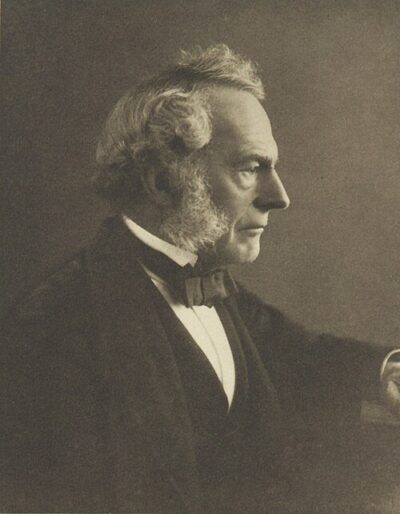
Stokes flow
Stokes flow is a fluid flow where advective inertial forces are small compared with viscous forces.
All 3 facts, and where they come from
Facts
3 facts · 0 confirmed by two sources · 0 cited · 3 from one source
Where this comes from
Papalocal keeps its own record. It started from these sources; what each one said is kept here as it was copied, so a change on their side never changes this page by itself. Tap one to read its version.
What Wikidata says · copied November 17, 2026 · revision 2398134232
- Described as
- fluid flow where advective inertial forces are small compared with viscous forces
- Other names
- creeping flow, creeping motion
- What it is
- flow type; scientific theory
- Named after
- Sir George Stokes, 1st Baronet
- Wikipedias with a page
- 16
Wikidata item Q674202 (wikidata.org/wiki/Q674202), public domain (CC0). Copied 2026-11-17.
What Wikipedia says · copied November 17, 2026 · revision 1374479156
Stokes flow (named after George Gabriel Stokes), also named creeping flow or creeping motion, is a type of fluid flow where advective inertial forces are small compared with viscous forces. The Reynolds number is low, i.e. Re≪1. This is a typical situation in flows where the fluid velocities are very slow, the viscosities are very large, or the length-scales of the flow are very small. Creeping flow was first studied to understand lubrication. In nature, this type of flow occurs in the swimming of microorganisms and sperm. In technology, it occurs in paint, MEMS devices, and in the flow of viscous polymers generally.
The equations of motion for Stokes flow, called the Stokes equations, are a linearization of the Navier–Stokes equations, and thus can be solved by a number of well-known methods for linear differential equations. The primary Green's function of Stokes flow is the Stokeslet, which is associated with a singular point force embedded in a Stokes flow. From its derivatives, other fundamental solutions can be obtained. The Stokeslet was first derived by Carl Wilhelm Oseen in 1927, although it was not named as such until 1953 by G. J. Hancock. The closed-form fundamental solutions for the generalized unsteady Stokes and Oseen flows associated with arbitrary time-dependent translational and rotational motions have been derived for the Newtonian and micropolar fluids.
From the Wikipedia article “Stokes flow” (en.wikipedia.org/wiki/Stokes_flow), by its contributors, under CC BY-SA 4.0 (creativecommons.org/licenses/by-sa/4.0/). Copied 2026-11-17; not changed.
Confirmed Two sources agree. Cited One source, and it names where it got it. One source One source, without a reference of its own. Sources disagree The sources disagree. We show the best-supported value and keep theirs below.