
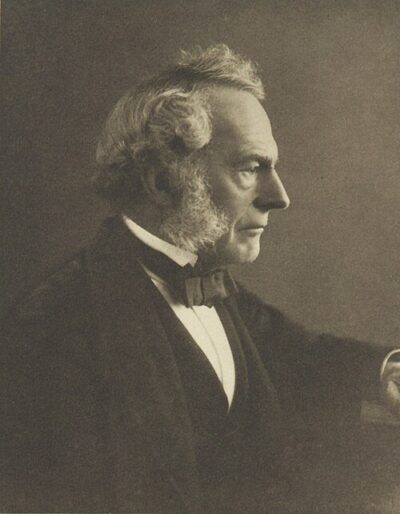
Sir George Stokes, 1st Baronet
Sir George Stokes, 1st Baronet was an Irish mathematician and physicist. Born August 13, 1819, in Skreen. Died February 1, 1903, in Cambridge. Positions held include member of the 24th Parliament of the United Kingdom (1887–1892), President of the Royal Society (1885–1890) and Lucasian Professor of Mathematics (1849–1903). Known for Navier–Stokes equations, Stokes' law and Stokes' law of sound attenuation. Educated at City of Bristol College and Pembroke College. Awards include Fellow of the Royal Society, Copley Medal and Pour le Mérite for Sciences and Arts order.
Facts
58 facts · 2 confirmed by two sources · 26 cited · 30 from one source
Where this comes from
Papalocal keeps its own record. It started from these sources; what each one said is kept here as it was copied, so a change on their side never changes this page by itself. Tap one to read its version.
What Wikidata says · copied November 16, 2026 · revision 2557892140
- Described as
- Irish mathematician and physicist (1819–1903)
- Other names
- George Stokes, Sir George Gabriel Stokes, Sir George Gabriel Stokes, 1st Baronet, Sir George Stokes
- Born
- August 13, 1819 · 11 references
- Died
- February 1, 1903 · 8 references
- Born in
- Skreen · 3 references
- Died in
- Cambridge · 4 references
- Buried in
- Mill Road Cemetery · 2 references
- Name at birth
- George Gabriel Stokes · 1 reference
- Citizen of
- Ireland; United Kingdom of Great Britain and Ireland
- Occupation
- mathematician · 2 references; physicist · 1 reference; politician · 1 reference; theologian · 1 reference; university teacher · 1 reference
- Positions held
- member of the 24th Parliament of the United Kingdom (1887–1892) · 1 reference; President of the Royal Society (1885–1890) · 1 reference; Lucasian Professor of Mathematics (1849–1903) · 1 reference; chairperson (1886–1903) · 2 references; Master of Pembroke College (1902–1903)
- Worked for
- University of Cambridge (2 times) (1841–1903) · 1 reference; Royal School of Mines (1851–1856) · 1 reference
- Education
- City of Bristol College (1835–1837) · 1 reference; Pembroke College (1837–1841) · 1 reference
- Member of
- Royal Society of London; Bavarian Academy of Sciences and Humanities; Göttingen Academy of Sciences and Humanities in Lower Saxony; American Academy of Arts and Sciences; Royal Prussian Academy of Sciences; Accademia Nazionale delle Scienze detta dei XL; Royal Society of Edinburgh (1865–) · 1 reference; National Academy of Sciences (1883–); Academy of Sciences of Turin (1898–) · 1 reference; Victoria Institute
- Known for
- Navier–Stokes equations; Stokes' law; Stokes' law of sound attenuation; Stokes' theorem; Stokes parameters; Stokes shift; Stokes flow; Stokes number; Stokes line
- Awards
- Fellow of the Royal Society (1851); Copley Medal (1893) · 1 reference; Pour le Mérite for Sciences and Arts order (1879); Helmholtz Medal (1900) · 1 reference; Rumford Medal (1852) · 1 reference; Actonian Prize (1886) · 1 reference; Gifford Lectures (1891) · 1 reference
- Field
- mathematics · 1 reference; mechanics; physics · 1 reference; politics · 1 reference; theology · 1 reference
- Spouse
- Mary Susanna Stokes · 1 reference
- Children
- Sir Arthur Romney Stokes, 2nd Baronet
- Father
- Gabriel Stokes · 1 reference
- Mother
- Elizabeth Haughton · 1 reference
- Religion
- Anglicanism
- Wikipedias with a page
- 57
Wikidata item Q155907 (wikidata.org/wiki/Q155907), public domain (CC0). Copied November 16, 2026.
What Wikipedia says · copied November 16, 2026 · revision 1385053430
Sir George Gabriel Stokes, 1st Baronet ( STOHKS; 13 August 1819 – 1 February 1903), was an Irish mathematician and physicist, born in County Sligo, Ireland, in the United Kingdom of Great Britain and Ireland. Stokes spent his entire career at the University of Cambridge, where he served as Lucasian Professor of Mathematics for 54 years—from 1849 until his death in 1903—the longest tenure held by any Lucasian Professor.
As a physicist, Stokes made seminal contributions to fluid mechanics, including the Navier–Stokes equations; and to optics, with notable works on polarisation and fluorescence. As a mathematician, he popularised Stokes' theorem in vector calculus and contributed to the theory of asymptotic expansions. Stokes, along with Felix Hoppe-Seyler, first demonstrated the oxygen transport function of haemoglobin, and showed colour changes produced by the aeration of haemoglobin solutions.
Stokes represented Cambridge University in the House of Commons from 1887 to 1892, sitting as a Conservative. He also served as President of the Royal Society from 1885 to 1890, and was briefly Master of Pembroke College, Cambridge. Stokes's extensive correspondence and his work as secretary of the Royal Society has led him to be referred to as a gatekeeper of Victorian science, with his contributions surpassing his own published papers.
- Born, in its opening lines
- August 13, 1819
- Died, in its opening lines
- February 1, 1903
From the Wikipedia article “Sir George Stokes, 1st Baronet” (en.wikipedia.org/wiki/Sir_George_Stokes,_1st_Baronet), by its contributors, under CC BY-SA 4.0 (creativecommons.org/licenses/by-sa/4.0/). Copied November 16, 2026; not changed.
Confirmed Two sources agree. Cited One source, and it names where it got it. One source One source, without a reference of its own. Sources disagree The sources disagree. We show the best-supported value and keep theirs below.
