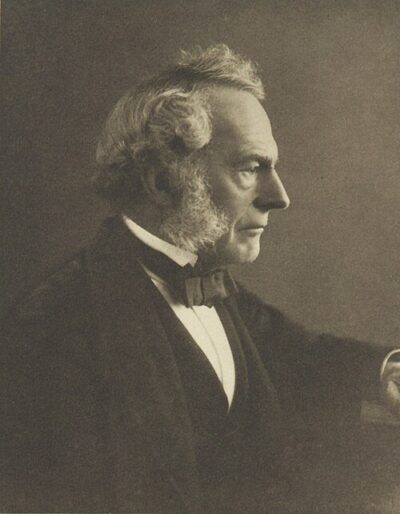
Stokes' theorem
Stokes' theorem is a theorem in vector calculus.
All 2 facts, and where they come from
Facts
2 facts · 0 confirmed by two sources · 0 cited · 2 from one source
Where this comes from
Papalocal keeps its own record. It started from these sources; what each one said is kept here as it was copied, so a change on their side never changes this page by itself. Tap one to read its version.
What Wikidata says · copied November 17, 2026 · revision 2547886293
- Described as
- theorem in vector calculus
- Other names
- circulation theorem, curl theorem, Kelvin–Stokes theorem, fundamental theorem for curls
- What it is
- theorem
- Named after
- Sir George Stokes, 1st Baronet
- Wikipedias with a page
- 36
Wikidata item Q467756 (wikidata.org/wiki/Q467756), public domain (CC0). Copied 2026-11-17.
What Wikipedia says · copied November 17, 2026 · revision 1384560326
Stokes' theorem, also known as the Kelvin–Stokes theorem, is a theorem in vector calculus that relates the behavior of a vector field along the edge of a surface to the behavior of its curl on the surface itself. In its usual three-dimensional form, it says that the total circulation of a vector field around a closed curve is equal to the total curl of the field through a surface bounded by that curve.
If Σ is an oriented surface with boundary ∂Σ, Stokes' theorem is commonly written as
∮∂Σ𝐅⋅d𝐫=∬Σ(∇×𝐅)⋅𝐧dS.
Here the left side is the line integral of the vector field around the boundary curve, while the right side is the surface integral of its curl over the surface. Informally, the theorem says that adding up the local rotation of a vector field across a surface gives the net circulation around its edge.
The theorem is also called the fundamental theorem for curls, the curl theorem, or the rotor theorem. It is a special case of the generalized Stokes theorem. In the language of differential forms, the vector field corresponds to a 1-form and its curl corresponds to the exterior derivative of that form.
From the Wikipedia article “Stokes' theorem” (en.wikipedia.org/wiki/Stokes'_theorem), by its contributors, under CC BY-SA 4.0 (creativecommons.org/licenses/by-sa/4.0/). Copied 2026-11-17; not changed.
Confirmed Two sources agree. Cited One source, and it names where it got it. One source One source, without a reference of its own. Sources disagree The sources disagree. We show the best-supported value and keep theirs below.