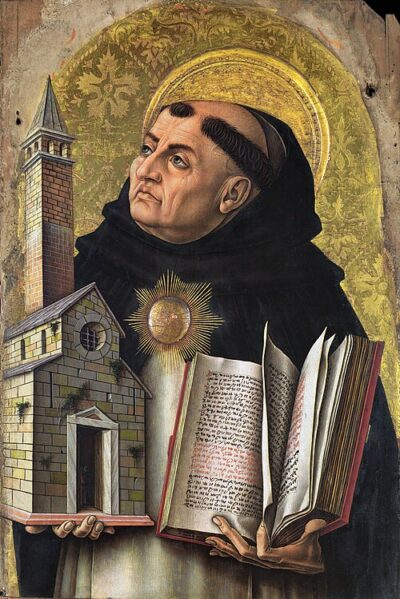
Summa contra Gentiles
Summa contra Gentiles is a major work by Thomas Aquinas. It came out in 1259.
- Came out
- 1200s (1259–1265)
- Written by
- Thomas Aquinas
- Genre
- treatise
All 6 facts, and where they come from
Facts
6 facts · 0 confirmed by two sources · 0 cited · 6 from one source
Where this comes from
Papalocal keeps its own record. It started from these sources; what each one said is kept here as it was copied, so a change on their side never changes this page by itself. Tap one to read its version.
What Wikidata says · copied November 17, 2026 · revision 2515874493
- Described as
- major work by Thomas Aquinas
- Other names
- Book on the truth of the Catholic faith against the errors of the unbelievers, Tractate on the universal faith, against the pagans, Tractate on the universal faith, against the errors of the unbelievers
- What it is
- reference work
- Written by
- Thomas Aquinas
- Genre
- treatise; essay
- Language
- medieval Latin
- Came out
- 1200s (1259–1265)
- Wikipedias with a page
- 17
Wikidata item Q604274 (wikidata.org/wiki/Q604274), public domain (CC0). Copied 2026-11-17.
What Wikipedia says · copied November 17, 2026 · revision 1384744695
The Summa contra Gentiles is one of the best-known treatises by Thomas Aquinas, written as four books between 1259 and 1265.
Whereas the Summa Theologiæ was written to explain the Christian faith to theology students, the Summa contra Gentiles is more apologetic in tone. While the last of the four books (parts) of the S.C.G. deals with topics of revealed theology such as trinity, incarnation, and the sacraments, the first three books limit themselves to natural theology: arguments on the basis of reason, Thomas believes, will be understood also by those who do not believe in Christian revelation.
From the Wikipedia article “Summa contra Gentiles” (en.wikipedia.org/wiki/Summa_contra_Gentiles), by its contributors, under CC BY-SA 4.0 (creativecommons.org/licenses/by-sa/4.0/). Copied 2026-11-17; not changed.
Confirmed Two sources agree. Cited One source, and it names where it got it. One source One source, without a reference of its own. Sources disagree The sources disagree. We show the best-supported value and keep theirs below.