Summa Theologica
Summa Theologica is a theological treatise by Thomas Aquinas. It came out in 1274. It is based on Summary of a passage from the Summa theologica.
- Came out
- 1274
- Written by
- Thomas Aquinas
- Genre
- treatise
All 8 facts, and where they come from
Facts
8 facts · 0 confirmed by two sources · 0 cited · 8 from one source
Where this comes from
Papalocal keeps its own record. It started from these sources; what each one said is kept here as it was copied, so a change on their side never changes this page by itself. Tap one to read its version.
What Wikidata says · copied November 17, 2026 · revision 2529062796
- Described as
- theological treatise by Thomas Aquinas
- Other names
- Summa, Summa Theologiae, Summa Theologiæ
- What it is
- reference work; treatise
- Written by
- Thomas Aquinas
- Genre
- treatise
- Language
- Ecclesiastical Latin; medieval Latin
- Based on
- Summary of a passage from the Summa theologica
- Came out
- 1274
- Wikipedias with a page
- 39
Wikidata item Q653871 (wikidata.org/wiki/Q653871), public domain (CC0). Copied 2026-11-17.
What Wikipedia says · copied November 17, 2026 · revision 1385707702
The Summa Theologiae or Summa Theologica (transl. 'Summary of Theology'), often referred to simply as the Summa, is the best-known work of Thomas Aquinas (1225–1274), a scholastic theologian and Doctor of the Church. It is a compendium of all of the main theological teachings of the Catholic Church. Presenting the reasoning for almost all points of Christian theology in the West, topics of the Summa follow the following cycle: God; Creation, Man; Man's purpose; Christ; the Sacraments; and back to God.
Although unfinished, it is "one of the classics of the history of philosophy and one of the most influential works of Western literature". It remains Aquinas's "most perfect work, the fruit of his mature years, in which the thought of his whole life is condensed".
The Summa is a more structured and expanded version of Aquinas's earlier Summa contra Gentiles, though the two were written for different purposes. Throughout the Summa, Aquinas aims to reconcile Aristotelian philosophy with Catholic theology. Although he broadly cites the Bible, patristic, scholastic, Islamic, Jewish, and pre-Christian Greek and Roman sources, his most referenced non-scriptural authors are Aristotle (whom he calls "the philosopher") and Augustine.
The Summa Theologiae was one of the main intellectual inspirations for Thomistic philosophy. It also had such a great influence on Dante Alighieri's Divine Comedy that Dante's epic poem has been called "the Summa in verse". The Summa Theologiae continues to be a major reference in the Western and Eastern Catholic Churches, and the mainline Protestant denominations (Anglicanism, Lutheranism, Methodism, and Reformed Christianity) for those seeking ordination to the diaconate or priesthood, for professed male or female religious life, or for laypersons studying philosophy and theology at the collegiate level.
From the Wikipedia article “Summa Theologica” (en.wikipedia.org/wiki/Summa_Theologica), by its contributors, under CC BY-SA 4.0 (creativecommons.org/licenses/by-sa/4.0/). Copied 2026-11-17; not changed.
Confirmed Two sources agree. Cited One source, and it names where it got it. One source One source, without a reference of its own. Sources disagree The sources disagree. We show the best-supported value and keep theirs below.
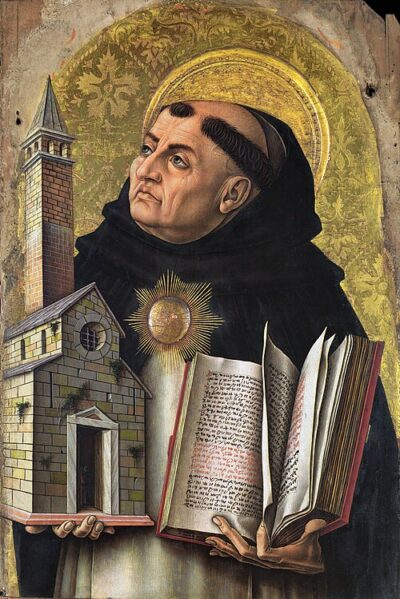
Picture: Tommaso : d'Aquino, via Wikimedia Commons · Public domain