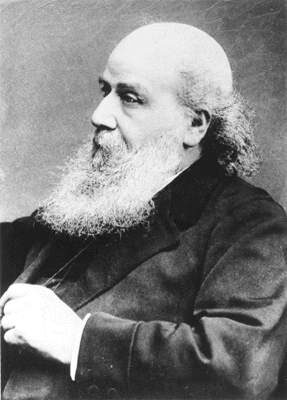
Sylvester's law of inertia
Sylvester's law of inertia is a theorem of matrix algebra of invariance properties under basis transformations.
All 2 facts, and where they come from
Facts
2 facts · 0 confirmed by two sources · 0 cited · 2 from one source
Where this comes from
Papalocal keeps its own record. It started from these sources; what each one said is kept here as it was copied, so a change on their side never changes this page by itself. Tap one to read its version.
What Wikidata says · copied November 17, 2026 · revision 2386886480
- Described as
- theorem of matrix algebra of invariance properties under basis transformations
- What it is
- theorem
- Named after
- James Joseph Sylvester
- Wikipedias with a page
- 20
Wikidata item Q1752621 (wikidata.org/wiki/Q1752621), public domain (CC0). Copied 2026-11-17.
What Wikipedia says · copied November 17, 2026 · revision 1360733178
Sylvester's law of inertia is a theorem in matrix algebra about certain properties of the coefficient matrix of a real quadratic form that remain invariant under a change of basis. Namely, if S is a symmetric matrix, then for any invertible matrix P, the numbers of positive, negative, and zero eigenvalues of S′=PSP𝖳 are constant (i.e., the inertia of S′ is constant). This result is particularly useful when S′ is diagonal, as the inertia of a diagonal matrix can easily be obtained by looking at the signs of its diagonal elements.
This property is named after James Joseph Sylvester, who published its proof in 1852.
From the Wikipedia article “Sylvester's law of inertia” (en.wikipedia.org/wiki/Sylvester's_law_of_inertia), by its contributors, under CC BY-SA 4.0 (creativecommons.org/licenses/by-sa/4.0/). Copied 2026-11-17; not changed.
Confirmed Two sources agree. Cited One source, and it names where it got it. One source One source, without a reference of its own. Sources disagree The sources disagree. We show the best-supported value and keep theirs below.