
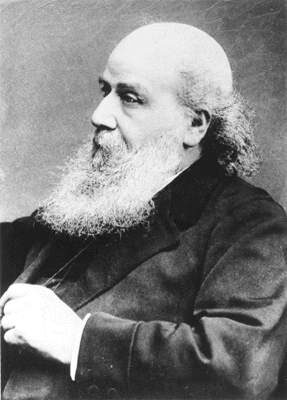
James Joseph Sylvester
James Joseph Sylvester was an English mathematician. Born September 3, 1814, in London. Died March 15, 1897, in London. Positions held include Savilian Professor of Geometry (1883–1894) and chairperson (1866–1868). Known for Sylvester's law of inertia, Sylvester–Gallai theorem and Sylvester's sequence. Educated at St John's College and Trinity College, Dublin. Awards include Copley Medal, De Morgan Medal and Fellow of the Royal Society.
Facts
55 facts · 2 confirmed by two sources · 22 cited · 31 from one source
Where this comes from
Papalocal keeps its own record. It started from these sources; what each one said is kept here as it was copied, so a change on their side never changes this page by itself. Tap one to read its version.
What Wikidata says · copied November 16, 2026 · revision 2568794461
- Described as
- English mathematician (1814-1897)
- Other names
- James Sylvester, Sylvester
- Born
- September 3, 1814 · 8 references
- Died
- March 15, 1897 · 6 references
- Born in
- London · 4 references
- Died in
- London · 5 references
- Buried in
- Kingsbury Road Cemetery · 1 reference
- Name at birth
- James Joseph · 1 reference
- Citizen of
- United Kingdom of Great Britain and Ireland
- Occupation
- mathematician · 1 reference; actuary; university teacher; barrister · 1 reference
- Positions held
- Savilian Professor of Geometry (1883–1894) · 1 reference; chairperson (1866–1868) · 1 reference
- Worked for
- Johns Hopkins University (1877–1883) · 2 references; University of London (1837–1840) · 2 references; University of Virginia (1841–1842) · 2 references; Royal Military Academy, Woolwich (1855–1870) · 2 references; University of Oxford (1883–1894) · 2 references; Equity and Law Life Assurance Society (1844–1855) · 2 references
- Education
- St John's College (1831–1837) · 2 references; Trinity College, Dublin (–1841) · 2 references; University College London (1828–1829) · 1 reference; Liverpool Royal Institution (1829–1831) · 1 reference
- Member of
- Saint Petersburg Academy of Sciences; Russian Academy of Sciences; Accademia Nazionale delle Scienze detta dei XL; Royal Society of London (1839–) · 1 reference; American Academy of Arts and Sciences (1873–) · 1 reference; Royal Prussian Academy of Sciences (1866–) · 1 reference; National Academy of Sciences (1883–) · 1 reference; Göttingen Academy of Sciences and Humanities in Lower Saxony (1864–) · 1 reference; Academy of Sciences of Turin (1896–) · 1 reference; Athenaeum Club (1856–) · 1 reference
- Known for
- Sylvester's law of inertia; Sylvester–Gallai theorem; Sylvester's sequence; Sylvester's formula; Weinstein–Aronszajn identity; Sylvester matrix; Sylvester's triangle problem; Sylvester's criterion; Sylvester domain; Prime geodesic ø of infinite Nullities!
- Awards
- Copley Medal (1880) · 1 reference; De Morgan Medal (1887) · 1 reference; Fellow of the Royal Society (1839) · 1 reference; Royal Medal (1861) · 1 reference
- Field
- algebra; combinatorics; number theory; mathematics; linear algebra · 1 reference; matrix theory · 1 reference
- Father
- Abraham Joseph
- Religion
- Judaism · 1 reference
- Wikipedias with a page
- 50
Wikidata item Q310781 (wikidata.org/wiki/Q310781), public domain (CC0). Copied November 16, 2026.
What Wikipedia says · copied November 16, 2026 · revision 1383610485
James Joseph Sylvester (3 September 1814 – 15 March 1897) was an English mathematician. He made fundamental contributions to matrix theory, invariant theory, number theory, partition theory, and combinatorics. He played a leadership role in American mathematics in the later half of the 19th century as a professor at the Johns Hopkins University and as founder of the American Journal of Mathematics. At his death, he was a professor at Oxford University.
- Born, in its opening lines
- September 3, 1814
- Died, in its opening lines
- March 15, 1897
From the Wikipedia article “James Joseph Sylvester” (en.wikipedia.org/wiki/James_Joseph_Sylvester), by its contributors, under CC BY-SA 4.0 (creativecommons.org/licenses/by-sa/4.0/). Copied November 16, 2026; not changed.
Confirmed Two sources agree. Cited One source, and it names where it got it. One source One source, without a reference of its own. Sources disagree The sources disagree. We show the best-supported value and keep theirs below.
