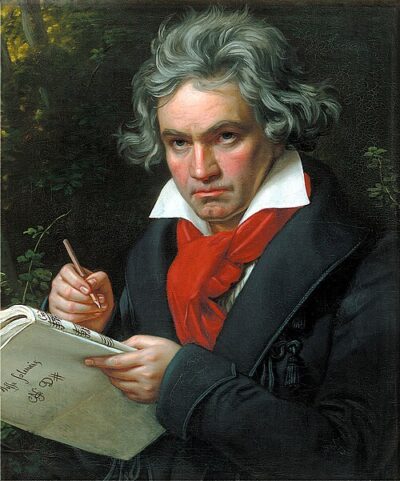
Symphony No. 9
Symphony No. 9 is a choral symphony by Ludwig van Beethoven. It came out in 1826.
- Released
- 1826
- Came out
- 1824
All 5 facts, and where they come from
Facts
5 facts · 0 confirmed by two sources · 3 cited · 2 from one source
Where this comes from
Papalocal keeps its own record. It started from these sources; what each one said is kept here as it was copied, so a change on their side never changes this page by itself. Tap one to read its version.
What Wikidata says · copied November 17, 2026 · revision 2569139602
- Described as
- choral symphony by Ludwig van Beethoven
- Other names
- Symphony No. 9 in D minor, Op. 125, Ode to Joy
- What it is
- musical work/composition
- Music by
- Ludwig van Beethoven · 1 reference
- Released
- 1826 · 1 reference
- Language
- German
- Came out
- 1824 · 1 reference
- Wikipedias with a page
- 66
Wikidata item Q11989 (wikidata.org/wiki/Q11989), public domain (CC0). Copied 2026-11-17.
What Wikipedia says · copied November 17, 2026 · revision 1385921259
The Symphony No. 9 in D minor, Op. 125, is a choral symphony, the final complete symphony by Ludwig van Beethoven, composed between 1822 and 1824. It was first performed in Vienna on 7 May 1824. The symphony is regarded by many critics and musicologists as a masterpiece of Western classical music and one of the supreme achievements in the history of music. One of the best-known works in common practice music, it stands as one of the most frequently performed symphonies in the world.
The Ninth was the first example of a major composer scoring vocal parts in a symphony. The final (4th) movement of the symphony, commonly known as the Ode to Joy, features four vocal soloists and a chorus in the parallel key of D major. The text was adapted from the "An die Freude (Ode to Joy)", a poem written by Friedrich Schiller in 1785 and revised in 1803, with additional text written by Beethoven. In the 20th century, an instrumental arrangement of the chorus was adopted by the Council of Europe, and later the European Union, as the Anthem of Europe.
In 2001, Beethoven's original, hand-written manuscript of the score, held by the Berlin State Library, was added by UNESCO to its Memory of the World International Register, becoming the first musical score so designated.
From the Wikipedia article “Symphony No. 9 (Beethoven)” (en.wikipedia.org/wiki/Symphony_No._9_(Beethoven)), by its contributors, under CC BY-SA 4.0 (creativecommons.org/licenses/by-sa/4.0/). Copied 2026-11-17; not changed.
Confirmed Two sources agree. Cited One source, and it names where it got it. One source One source, without a reference of its own. Sources disagree The sources disagree. We show the best-supported value and keep theirs below.
Picture: Wikimedia Commons: Beethoven Ninth Symphony.png · See Commons file page