
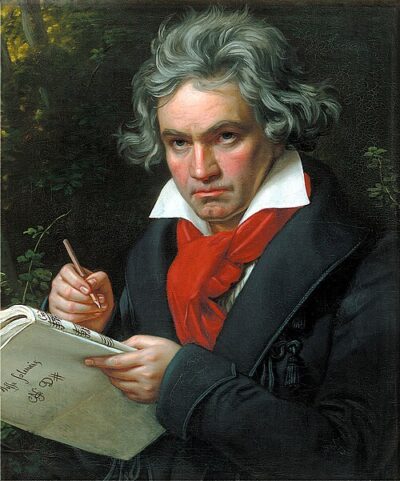
Ludwig van Beethoven
Ludwig van Beethoven was a German composer. Born December 16, 1770, in Bonn. Died March 26, 1827, in Vienna. Known for Für Elise, Symphony No. 9 and Piano Sonata No. 14. Awards include Bröckemännche Award.
Facts
49 facts · 1 confirmed by two sources · 14 cited · 32 from one source · 2 where the sources disagree
What’s different
- Born: we show December 16, 1770 (Sources disagree). Wikipedia says December 17, 1770
- Buried in: we show Vienna Central Cemetery (1888–) (Sources disagree). Wikidata also lists Cemetery Währinger Park and grave of Ludwig van Beethoven
Where this comes from
Papalocal keeps its own record. It started from these sources; what each one said is kept here as it was copied, so a change on their side never changes this page by itself. Tap one to read its version.
What Wikidata says · copied November 16, 2026 · revision 2567720737
- Described as
- German composer (1770-1827)
- Other names
- Ludwik van Beethoven, Ludwig von Beethoven, Ludvig van Beethoven, L. v. Beethoven, L. van Betkhoven, L. Bethovenas, Louis van Beethoven, L. van Beethoven, Beethoven
- Born
- December 16, 1770 · 8 references
- Died
- March 26, 1827 · 26 references
- Born in
- Bonn · 7 references
- Died in
- Vienna · 6 references
- Buried in
- Vienna Central Cemetery (1888–); Cemetery Währinger Park (1827–1888); grave of Ludwig van Beethoven
- Cause of death
- liver cirrhosis · 1 reference
- Citizen of
- Electorate of Cologne (–1794) · 1 reference; Austrian Empire (1822–) · 1 reference
- Occupation
- composer · 4 references; pianist · 1 reference; conductor; music educator; organist; virtuoso; improviser; violinist · 1 reference
- Member of
- Royal Netherlands Academy of Arts and Sciences · 1 reference
- Genre
- classical music · 1 reference; art music · 1 reference; opera · 1 reference; symphony · 1 reference; sonata · 1 reference
- Instrument
- piano; violin · 1 reference
- Known for
- Für Elise; Symphony No. 9; Piano Sonata No. 14; Missa Solemnis; Piano Sonata No. 8; Symphony No. 5; Symphony No. 6; Piano Sonata No. 21; Piano Sonata No. 23; Violin Sonata No. 9
- Awards
- Bröckemännche Award (2020) · 1 reference
- Field
- classical music; symphony; string quartet; chamber music; traditional folk song; string trio
- Father
- Johann van Beethoven · 1 reference
- Mother
- Maria Magdalena van Beethoven · 1 reference
- Siblings
- Kaspar Anton Karl van Beethoven; Nicolaus Johann van Beethoven · 1 reference; Johann Peter Anton Leym · 1 reference
- Religion
- Catholicism · 1 reference
- Lived in
- Beethoven House
- Website
- https://beethoven.de · 1 reference
- Wikipedias with a page
- 274
Wikidata item Q255 (wikidata.org/wiki/Q255), public domain (CC0). Copied November 16, 2026.
What Wikipedia says · copied November 16, 2026 · revision 1385664155
Ludwig van Beethoven (baptised 17 December 1770 – 26 March 1827) was a German composer and pianist. A seminal figure in the history of music, his personal style was a key driver of the transition from Classical to Romantic music. He expanded instrumental forms such as the symphony, the piano sonata, and the string quartet. Beethoven is widely revered as one of the greatest composers of all time, and his compositions are among the most performed in the world.
Born in Bonn, Beethoven was a musical prodigy. He was initially taught intensively by his father, Johann van Beethoven, and later by Christian Gottlob Neefe. He found relief from a dysfunctional home life with the family of Helene von Breuning, whose children he loved, befriended, and taught piano. At age 21, he moved to Vienna, which became his base, and studied composition with Joseph Haydn. Beethoven gained a reputation as a virtuoso pianist, and was soon patronized by Karl Alois, Prince Lichnowsky for compositions, which resulted in his three Piano Trios, Op. 1, the earliest works to which he accorded an opus number, in 1795. His Pathétique Sonata was composed in 1798. Around this time, Beethoven began experiencing symptoms of hearing loss.
His career is divided into three periods. In the first, he composed in the classical style of Haydn and Wolfgang Amadeus Mozart. Beethoven's First Symphony premiered in 1800, and his first set of string quartets was published in 1801. The Moonlight Sonata, dedicated to his pupil Julie Guicciardi, is one of his most popular works. In the middle period (1802–1812), he developed a distinctive style. His Third (Eroica) and Fifth Symphonies premiered in 1805 and 1808, respectively. The former was unprecedented in scale and scope. His opera, Fidelio, premiered in 1805, and was later revised. His Violin Concerto appeared in 1806. His Razumovsky quartets were published in 1808. Other middle works include the Waldstein and Appassionata sonatas for piano, the Kreutzer sonata for violin and his Seventh Symphony. His Emperor piano concerto premiered in 1811, without the composer as soloist.
His late period (1812–1827) included some of his most innovative works. His Missa solemnis and his final symphony, the Ninth, premiered in 1824. The latter was the first major example of a choral symphony. His Diabelli Variations and late piano sonatas, particularly the Hammerklavier, are summits of the keyboard literature. His late string quartets, including the Große Fuge, of 1825–1826, are considered pinnacles of the genre. After several months of illness, which left him bedridden, Beethoven died on 26 March 1827 at the age of 56.
- Born, in its opening lines
- December 17, 1770
- Died, in its opening lines
- March 26, 1827
From the Wikipedia article “Ludwig van Beethoven” (en.wikipedia.org/wiki/Ludwig_van_Beethoven), by its contributors, under CC BY-SA 4.0 (creativecommons.org/licenses/by-sa/4.0/). Copied November 16, 2026; not changed.
Confirmed Two sources agree. Cited One source, and it names where it got it. One source One source, without a reference of its own. Sources disagree The sources disagree. We show the best-supported value and keep theirs below.
