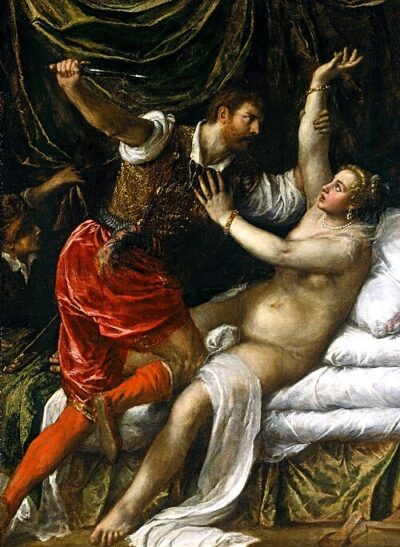
Tarquin and Lucretia
Tarquin and Lucretia is a painting by Titian in the Fitzwilliam Museum, Cambridge. It came out in 1571.
- Came out
- 1571
- Created by
- Titian
- Genre
- history painting
All 5 facts, and where they come from
Facts
5 facts · 0 confirmed by two sources · 3 cited · 2 from one source
Where this comes from
Papalocal keeps its own record. It started from these sources; what each one said is kept here as it was copied, so a change on their side never changes this page by itself. Tap one to read its version.
What Wikidata says · copied November 17, 2026 · revision 2509318911
- Described as
- painting by Titian in the Fitzwilliam Museum, Cambridge
- What it is
- painting · 1 reference
- Created by
- Titian · 1 reference
- Genre
- history painting; mythological painting
- Came out
- 1571 · 1 reference
- Wikipedias with a page
- 15
Wikidata item Q1652981 (wikidata.org/wiki/Q1652981), public domain (CC0). Copied 2026-11-17.
What Wikipedia says · copied November 17, 2026 · revision 1375738109
Tarquin and Lucretia is an oil painting by Titian completed in 1571, when the artist was in his eighties, for Philip II of Spain. It is signed, and considered to have been finished entirely by Titian himself. It is one of a series of great works from Titian's last years, but unlike some of these, is fully finished. It is now in the Fitzwilliam Museum in Cambridge, England.
The story from early Roman history (or legend) of the rape of Lucretia by Sextus Tarquinius (Tarquin), and her subsequent suicide, was a popular subject in Renaissance art. Tarquin raped Lucretia after threatening to kill her if she rejected his advances; this is the moment shown here. The next day she exposed him and committed suicide, prompting the Romans to revolt and overthrow Tarquin's father Tarquin the Proud, the last king of Rome, and establish the Roman Republic. This is traditionally dated to 509 BC. Violent subjects are characteristic of Titian's last years, mostly drawn from mythology or religion, but the directness of this composition stands out among them.
The refinement of the poses of the figures is reflected in other contemporary versions of the painting. By this late stage in his career, Titian often took many years over paintings, setting them aside for long periods, only returning to them later. This painting is fully finished, and had been in progress for several years. As one of the latest documented and fully finished paintings by Titian, it is evidence for the much-debated question of whether other late Titians were ever finished or not.
From the Wikipedia article “Tarquin and Lucretia” (en.wikipedia.org/wiki/Tarquin_and_Lucretia), by its contributors, under CC BY-SA 4.0 (creativecommons.org/licenses/by-sa/4.0/). Copied 2026-11-17; not changed.
Confirmed Two sources agree. Cited One source, and it names where it got it. One source One source, without a reference of its own. Sources disagree The sources disagree. We show the best-supported value and keep theirs below.
Picture: Titian, via Wikimedia Commons · Public domain