
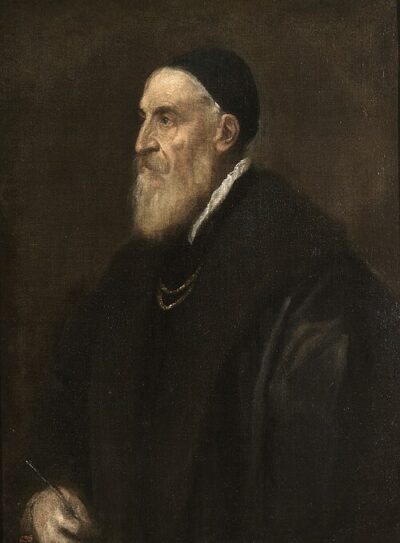
Titian
Titian was an Italian painter (c.1490–1576). Born 1490, in Pieve di Cadore. Died August 27, 1576, in Venice. Positions held include court painter. Known for Woman with a Mirror, The Crowning with Thorns and Madonna of the Rabbit. Awards include Order of the Golden Spur.
Facts
40 facts · 0 confirmed by two sources · 15 cited · 25 from one source
Where this comes from
Papalocal keeps its own record. It started from these sources; what each one said is kept here as it was copied, so a change on their side never changes this page by itself. Tap one to read its version.
What Wikidata says · copied November 16, 2026 · revision 2569929544
- Described as
- Italian painter (c.1490–1576)
- Other names
- dit le Titien Titiano Vecelli da Cadore, dit Le Titien Titianus Vecellio, Tiziani, Vicelli, tizian vecellio, Detiano, Veccelli Titian genoemd Titiaan, Thitsian, called Titian Veccellio, Titiano, Ticiano Vecelio, de Cador Titien Vecelli
- Born
- 1490 · 2 references
- Died
- August 27, 1576 · 5 references
- Born in
- Pieve di Cadore · 3 references
- Died in
- Venice · 4 references
- Buried in
- Santa Maria Gloriosa dei Frari · 2 references
- Cause of death
- plague
- Citizen of
- Republic of Venice
- Occupation
- painter · 5 references; draftsperson · 3 references; architectural drafter · 1 reference; printmaker · 1 reference; visual artist · 1 reference
- Positions held
- court painter
- Member of
- Accademia delle Arti del Disegno
- Genre
- portrait painting · 1 reference; religious painting · 1 reference; mythological painting · 1 reference; nude · 1 reference; history painting · 1 reference; portrait · 1 reference
- Known for
- Woman with a Mirror · 1 reference; The Crowning with Thorns · 1 reference; Madonna of the Rabbit · 1 reference; Venus of Urbino · 1 reference; Equestrian Portrait of Charles V; Pope Paul III and His Grandsons; Tarquin and Lucretia; The Martyrdom of Saint Lawrence · 1 reference; Venus with a Mirror · 1 reference; Cherub · 1 reference
- Awards
- Order of the Golden Spur · 1 reference
- Field
- painting · 1 reference
- Spouse
- Cecilia Soldano (1525–1530) · 1 reference
- Children
- Orazio Vecellio · 1 reference; Tizianello · 1 reference; Lavinia Vecellio · 1 reference
- Father
- Gregorio Vecellio · 1 reference
- Siblings
- Francesco Vecellio · 1 reference; Tommaso Vecellio · 1 reference
- Religion
- Catholicism
- Wikipedias with a page
- 109
Wikidata item Q47551 (wikidata.org/wiki/Q47551), public domain (CC0). Copied November 16, 2026.
What Wikipedia says · copied November 16, 2026 · revision 1384470196
Tiziano Vecellio (Italian: [titˈtsjaːno veˈtʃɛlljo]; c. 1488/1490 – 27 August 1576), Latinized as Titianus, hence known in English as Titian ( TISH-ən), was an Italian Renaissance painter. The most important artist of Renaissance Venetian painting, he was born in Pieve di Cadore, near Belluno.
Titian was one of the most versatile of Italian painters, equally adept with portraits, landscape backgrounds, and mythological and religious subjects. His painting methods, particularly in the application and use of colour, exerted a profound influence not only on painters of the late Italian Renaissance, but on future generations of Western artists.
His career was successful from the start, and he became sought after by patrons, initially from Venice and its possessions, then joined by the north Italian princes, and finally the Habsburgs and the papacy. Along with Giorgione, he is considered a founder of the Venetian school of Italian Renaissance painting. In 1590, the painter and art theorist Giovanni Paolo Lomazzo described Titian as "the sun amidst small stars not only among the Italians but all the painters of the world".
During his long life, Titian's artistic manner changed drastically, but he retained a lifelong interest in colour. Although his mature works may not contain the vivid, luminous tints of his early pieces, they are remarkable and original in their loose brushwork and subtlety of tone.
From the Wikipedia article “Titian” (en.wikipedia.org/wiki/Titian), by its contributors, under CC BY-SA 4.0 (creativecommons.org/licenses/by-sa/4.0/). Copied November 16, 2026; not changed.
Confirmed Two sources agree. Cited One source, and it names where it got it. One source One source, without a reference of its own. Sources disagree The sources disagree. We show the best-supported value and keep theirs below.
