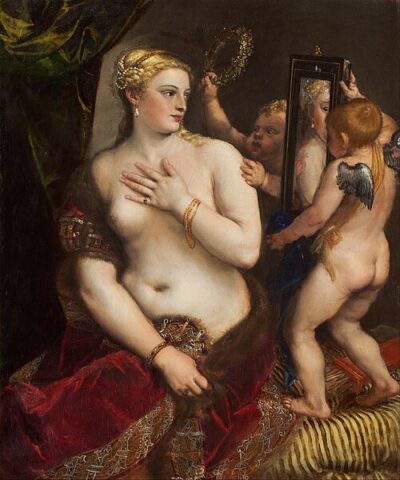
Venus with a Mirror
Venus with a Mirror is a painting by Titian in Washington, D.C. It came out in 1555.
- Came out
- 1555
- Created by
- Titian
- Genre
- mythological painting
All 8 facts, and where they come from
Facts
8 facts · 0 confirmed by two sources · 0 cited · 8 from one source
Where this comes from
Papalocal keeps its own record. It started from these sources; what each one said is kept here as it was copied, so a change on their side never changes this page by itself. Tap one to read its version.
What Wikidata says · copied November 17, 2026 · revision 2536433008
- Described as
- painting by Titian in Washington, D.C.
- What it is
- painting
- Created by
- Titian
- Genre
- mythological painting; nude
- Came out
- 1555
- Country
- United States
- Owned by
- Titian (1555–1576); Tizianello (1576–1581)
- Wikipedias with a page
- 15
Wikidata item Q7920648 (wikidata.org/wiki/Q7920648), public domain (CC0). Copied 2026-11-17.
What Wikipedia says · copied November 17, 2026 · revision 1381019160
Venus with a Mirror (c. 1555) is a painting by Titian, now in the National Gallery of Art in Washington, DC, and it is considered to be one of the collection's highlights.
The pose of the Venus resembles the classical statues of the Venus de' Medici in Florence or the Capitoline Venus in Rome, which Titian may have seen when he wrote that was "learning from the marvelous ancient stones." The painting is said to celebrate the ideal beauty of the female form, or to be a critique of vanity, or perhaps both. It was copied by several later artists, including Peter Paul Rubens and Anthony van Dyck.
Titian made a number of paintings of the same subject, but this is believed to be the earliest and the only version to be entirely by the hand of Titian, without additions by his assistants. It remained in his house until his death in 1576.
From the Wikipedia article “Venus with a Mirror” (en.wikipedia.org/wiki/Venus_with_a_Mirror), by its contributors, under CC BY-SA 4.0 (creativecommons.org/licenses/by-sa/4.0/). Copied 2026-11-17; not changed.
Confirmed Two sources agree. Cited One source, and it names where it got it. One source One source, without a reference of its own. Sources disagree The sources disagree. We show the best-supported value and keep theirs below.
Picture: Titian, via Wikimedia Commons · Public domain