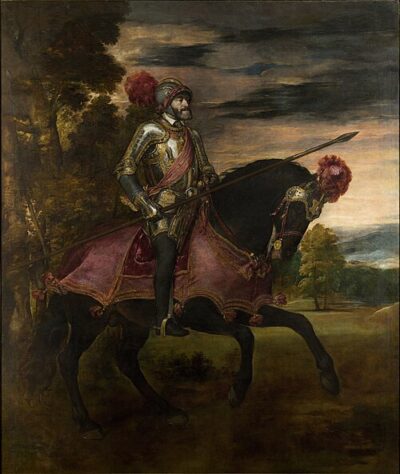
Equestrian Portrait of Charles V
Equestrian Portrait of Charles V is a painting by Titian. It came out in 1548.
- Came out
- 1548
- Created by
- Titian
- Genre
- equestrian portrait
- Country of origin
- Holy Roman Empire
All 6 facts, and where they come from
Facts
6 facts · 0 confirmed by two sources · 6 cited · 0 from one source
Where this comes from
Papalocal keeps its own record. It started from these sources; what each one said is kept here as it was copied, so a change on their side never changes this page by itself. Tap one to read its version.
What Wikidata says · copied November 17, 2026 · revision 2569635464
- Described as
- painting by Titian
- Other names
- Charles V at Mühlberg
- What it is
- painting · 1 reference
- Created by
- Titian · 1 reference
- Genre
- equestrian portrait · 1 reference
- Country of origin
- Holy Roman Empire · 1 reference
- Came out
- 1548 · 2 references
- Owned by
- Ferdinand VII of Spain (1814) · 1 reference
- Wikipedias with a page
- 23
Wikidata item Q1123378 (wikidata.org/wiki/Q1123378), public domain (CC0). Copied 2026-11-17.
What Wikipedia says · copied November 17, 2026 · revision 1373919433
Equestrian Portrait of Charles V (also Emperor Charles V on Horseback or Charles V at Mühlberg) is an oil-on-canvas painting by the Italian Renaissance artist Titian. Created between April and September 1548 while Titian was at the imperial court of Augsburg, it is a tribute to Charles V, Holy Roman Emperor, following his victory in the April 1547 Battle of Mühlberg against the Protestant armies.
The portrait in part gains its impact by its directness and sense of contained power: the horse's strength seems just in check, and Charles' brilliantly shining armour and the painting's deep reds are reminders of battle and heroism. According to Hugh Trevor-Roper, he "does not exult in his victory. He is staid, controlled, pensive, but serene". Titian recorded all of the foreground elements—the horse, its caparison, and the rider's armour—from those used in the actual battle. Both the armour and harness survive, and are kept at the Royal Armoury in Madrid. It was in the Spanish royal collection until transferred to the Museo del Prado in 1827.
From the Wikipedia article “Equestrian Portrait of Charles V” (en.wikipedia.org/wiki/Equestrian_Portrait_of_Charles_V), by its contributors, under CC BY-SA 4.0 (creativecommons.org/licenses/by-sa/4.0/). Copied 2026-11-17; not changed.
Confirmed Two sources agree. Cited One source, and it names where it got it. One source One source, without a reference of its own. Sources disagree The sources disagree. We show the best-supported value and keep theirs below.
Picture: Titian, via Wikimedia Commons · Public domain