
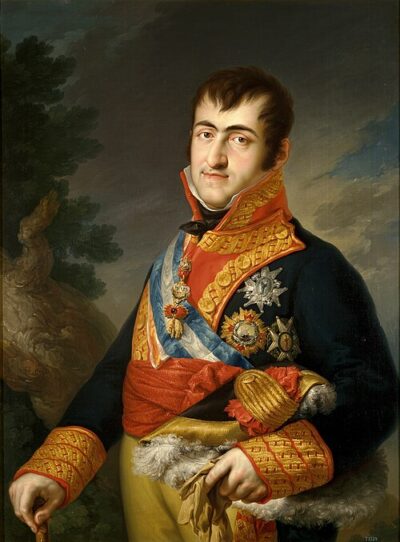
Ferdinand VII of Spain
Ferdinand VII of Spain was a King of Spain (1784–1833) (r. 1808; 1813–1833). Born October 14, 1784, in Royal Monastery of San Lorenzo de El Escorial. Died September 29, 1833, in Royal Palace of Madrid. Positions held include Monarch of Spain (2 times) (1808–1833), Grand Master of the Order of Santiago and Head of State of Spain (2 times) (1808–1833). Known for Will of Ferdinand VII of Spain. Awards include Knight of the Order of the Holy Spirit, Knight of the Order of Saint Michael and Knight of the Order of the Golden Fleece.
Facts
45 facts · 2 confirmed by two sources · 7 cited · 36 from one source
Where this comes from
Papalocal keeps its own record. It started from these sources; what each one said is kept here as it was copied, so a change on their side never changes this page by itself. Tap one to read its version.
What Wikidata says · copied November 16, 2026 · revision 2565822044
- Described as
- King of Spain (1784–1833) (r. 1808; 1813–1833)
- Other names
- Ferdinand the Desired, The Felon King, Fernando VII, Ferdinand VII
- Born
- October 14, 1784 · 6 references
- Died
- September 29, 1833 · 7 references
- Born in
- Royal Monastery of San Lorenzo de El Escorial · 1 reference
- Died in
- Royal Palace of Madrid · 1 reference
- Buried in
- Royal Crypt of the Royal Monastery of San Lorenzo de El Escorial
- Citizen of
- Spain
- Occupation
- ruler
- Positions held
- Monarch of Spain (2 times) (1808–1833); Grand Master of the Order of Santiago; Head of State of Spain (2 times) (1808–1833)
- Known for
- Will of Ferdinand VII of Spain
- Awards
- Knight of the Order of the Holy Spirit; Knight of the Order of Saint Michael; Knight of the Order of the Golden Fleece (1784) · 2 references; Order of St. Andrew; Collar of the Order of Isabella the Catholic; Order of Saint Ferdinand; Grand Cross of the Royal and Military Order of Saint Hermenegild; Order of Montesa; Order of Alcántara; Order of Calatrava; Grand Cross of the Legion of Honour; Order of the Garter; Grand Cross of the Sash of the Three Orders · 1 reference; Order of Saint Januarius; Knight Grand Cross of the Order of Saint Ferdinand and of Merit
- Spouse
- Maria Antonia of Naples and Sicily (1802–1806) · 1 reference; Queen Maria Isabel of Spain (1816–1818) · 1 reference; Maria Josepha Amalia of Saxony (1819–1829) · 1 reference; Maria Christina of the Two Sicilies (1829–1833) · 1 reference
- Children
- Isabella II of Spain · 1 reference; Luisa Fernanda of Spain, Duchess of Montpensier; Infanta María Luisa Isabel of Spain · 1 reference; unnamed daughter de Borbón · 1 reference; Carlos Luis de Borbón y Bragança
- Father
- Charles IV of Spain
- Mother
- Maria Luisa of Parma
- Siblings
- Maria Isabella of Spain; Maria Luisa I, Duchess of Lucca; Carlota Joaquina of Spain; Infanta María Amalia of Spain; Carlos de Borbón y Borbón-Parma; Infante Francisco de Paula of Spain
- Religion
- Catholic Church
- Military rank
- Captain general of the Army
- Wikipedias with a page
- 77
Wikidata item Q186256 (wikidata.org/wiki/Q186256), public domain (CC0). Copied November 16, 2026.
What Wikipedia says · copied November 16, 2026 · revision 1380801237
Ferdinand VII (Spanish: Fernando VII; 14 October 1784 – 29 September 1833) was King of Spain and the Indies during the early 19th century, and king of the Spains during the Spanish liberal period. He reigned as a prisoner of Napoleon, in absentia, or without effective sovereignty during the periods of Spanish liberalism, 1808–1813 and 1820–1823 (Trienio Liberal). Before 1813, he was known as el Deseado (the Desired), and after, as el Rey Felón (the Felon King).
Born in Madrid at El Escorial, Ferdinand was heir apparent to the Spanish throne in his youth. Following the 1808 Tumult of Aranjuez, he ascended the throne. That year, Napoleon overthrew him; he linked his monarchy to counter-revolution and reactionary policies that produced a deep rift in Spain between his forces on the right and liberals on the left. Back in power in December 1813, he re-established the absolutist monarchy and rejected the liberal constitution of 1812. A revolt in 1820 led by Rafael del Riego forced him to restore the constitution, starting the Liberal Triennium, a three-year period of liberal rule. In 1823, the Congress of Verona authorised a successful French intervention, restoring him to absolute power for the second time. He suppressed the liberal press from 1814 to 1833, jailing many of its editors and writers.
Under his rule, the liberal revolution took place throughout the Spanish Empire; Spanish America obtained its independence and Spain entered into a large-scale civil war upon his death. His political legacy has remained contested since his death; some historians regard him as incompetent, despotic, and short-sighted.
- Born, in its opening lines
- October 14, 1784
- Died, in its opening lines
- September 29, 1833
From the Wikipedia article “Ferdinand VII” (en.wikipedia.org/wiki/Ferdinand_VII), by its contributors, under CC BY-SA 4.0 (creativecommons.org/licenses/by-sa/4.0/). Copied November 16, 2026; not changed.
Confirmed Two sources agree. Cited One source, and it names where it got it. One source One source, without a reference of its own. Sources disagree The sources disagree. We show the best-supported value and keep theirs below.
