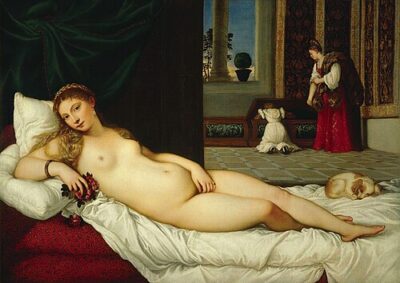
Venus of Urbino
Venus of Urbino is a painting by Titian. It came out in 1538.
- Came out
- 1538
- Created by
- Titian
- Genre
- mythological painting
- Country of origin
- Republic of Venice
All 6 facts, and where they come from
Facts
6 facts · 0 confirmed by two sources · 3 cited · 3 from one source
Where this comes from
Papalocal keeps its own record. It started from these sources; what each one said is kept here as it was copied, so a change on their side never changes this page by itself. Tap one to read its version.
What Wikidata says · copied November 17, 2026 · revision 2568661994
- Described as
- painting by Titian
- What it is
- painting · 1 reference
- Created by
- Titian · 1 reference
- Genre
- mythological painting; nude
- Country of origin
- Republic of Venice
- Came out
- 1538 · 1 reference
- Wikipedias with a page
- 40
Wikidata item Q727875 (wikidata.org/wiki/Q727875), public domain (CC0). Copied 2026-11-17.
What Wikipedia says · copied November 17, 2026 · revision 1372790812
The Venus of Urbino (also known as Reclining Venus) is an oil painting by Italian painter Titian, depicting a nude young woman, traditionally identified with the goddess Venus, reclining on a couch or bed in the sumptuous surroundings of a Renaissance palace. Work on the painting seems to have begun anywhere from 1532 or 1534, and was perhaps completed in 1534, but not sold until 1538. It is currently held in the Galleria degli Uffizi in Florence.
The figure’s pose derives from the Dresden Venus made around 1510–11, traditionally attributed to Giorgione but with the landscape completed by Titian. In this painting, Titian places Venus indoors, meets the viewer’s gaze, and makes her sensuality explicit. Iconographic interpretations of the painting among art historians fall into two groups; both agree that the painting has a powerful erotic charge, but beyond that, it is seen either as a portrait of a courtesan, perhaps Zaffetta, or as a painting celebrating the marriage of its first owner (who according to some may not have commissioned it).
This disagreement forms part of a wider debate on the meaning of the mainly Venetian tradition of the reclining female nude, which Titian had created, or helped to create. The woman's intimate gesture has been interpreted by some scholars to represent masturbation, an act linked to Renaissance marriage customs, where female arousal—including self-stimulation—was believed to aid conception and ensure successful consummation.
For Charles Hope, "It has yet to be shown that the most famous example of this genre, Titian's Venus of Urbino, is anything other than a representation of a beautiful nude woman on a bed, devoid of classical or even allegorical content". Even the indefatigable finder of allegories drawing on Renaissance Neoplatonism, Edgar Wind, had to admit that in this case "an undisguised hedonism had at last dispelled the Platonic metaphors".
From the Wikipedia article “Venus of Urbino” (en.wikipedia.org/wiki/Venus_of_Urbino), by its contributors, under CC BY-SA 4.0 (creativecommons.org/licenses/by-sa/4.0/). Copied 2026-11-17; not changed.
Confirmed Two sources agree. Cited One source, and it names where it got it. One source One source, without a reference of its own. Sources disagree The sources disagree. We show the best-supported value and keep theirs below.
Picture: Titian, via Wikimedia Commons · Public domain