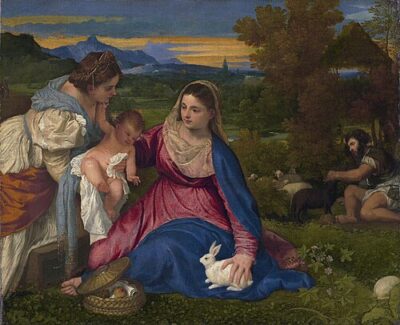
Madonna of the Rabbit
Madonna of the Rabbit is a painting by Titian. It came out in 1530.
- Came out
- 1530
- Created by
- Titian
- Genre
- religious art
- Country of origin
- Republic of Venice
All 7 facts, and where they come from
Facts
7 facts · 0 confirmed by two sources · 6 cited · 1 from one source
Where this comes from
Papalocal keeps its own record. It started from these sources; what each one said is kept here as it was copied, so a change on their side never changes this page by itself. Tap one to read its version.
What Wikidata says · copied November 17, 2026 · revision 2533770121
- Described as
- painting by Titian
- Other names
- The Madonna of the Rabbit, Virgin with the Rabbit
- What it is
- painting · 1 reference
- Created by
- Titian · 1 reference
- Genre
- religious art · 1 reference
- Country of origin
- Republic of Venice
- Came out
- 1530 · 2 references
- Owned by
- Federico II Gonzaga, Duke of Mantua (1530–1540) · 1 reference; Vincenzo II Gonzaga, Duke of Mantua (–1627) · 2 references
- Wikipedias with a page
- 10
Wikidata item Q24249 (wikidata.org/wiki/Q24249), public domain (CC0). Copied 2026-11-17.
What Wikipedia says · copied November 17, 2026 · revision 1361280979
The Madonna of the Rabbit (French: Vierge au lapin) is an oil painting by Titian, dated to 1530 and now held in the Louvre in Paris. It is signed "Ticianus f." and is named after the white rabbit held in Mary's left hand. The rabbit is a symbol of fertility and – due to its whiteness – of Mary's purity and the mystery of the Incarnation, and is also a symbol of her virginity; female rabbits and hares can conceive a second litter of offspring while still pregnant with the first, resulting in their being able to give birth seemingly without having been impregnated.
From the Wikipedia article “Madonna of the Rabbit” (en.wikipedia.org/wiki/Madonna_of_the_Rabbit), by its contributors, under CC BY-SA 4.0 (creativecommons.org/licenses/by-sa/4.0/). Copied 2026-11-17; not changed.
Confirmed Two sources agree. Cited One source, and it names where it got it. One source One source, without a reference of its own. Sources disagree The sources disagree. We show the best-supported value and keep theirs below.
Picture: Titian, via Wikimedia Commons · Public domain