The Age of Reason
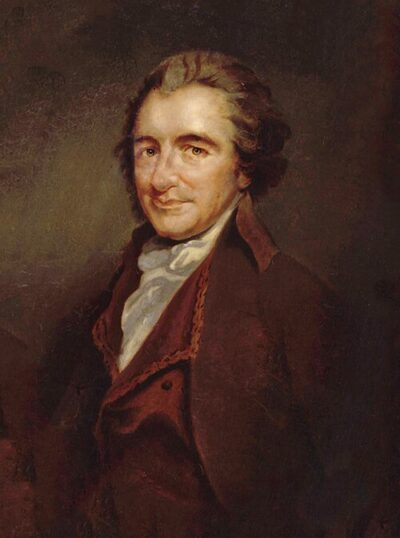
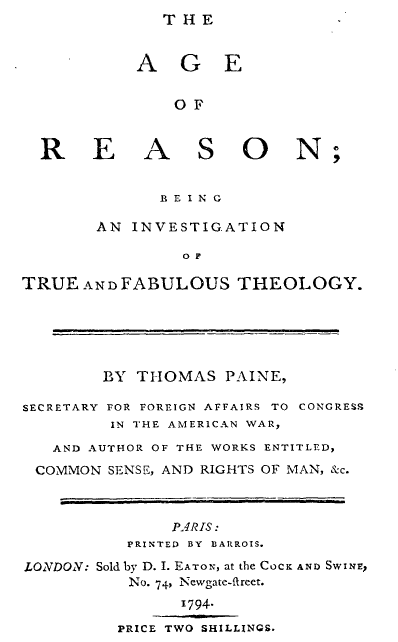
The Age of Reason is an English-language compilation of deistic pamphlets by Thomas Paine; accuses that the Christian Church is corrupt, rejects miracles and the sanctity of the Bible, promotes natural religion and argues for a creator-god and reason in favor of revelation. It came out in 1794.
- Published
- 1794
- Written by
- Thomas Paine
- Genre
- essay
All 5 facts, and where they come from
Facts
5 facts · 0 confirmed by two sources · 0 cited · 5 from one source
Where this comes from
Papalocal keeps its own record. It started from these sources; what each one said is kept here as it was copied, so a change on their side never changes this page by itself. Tap one to read its version.
What Wikidata says · copied November 16, 2026 · revision 2526780823
- Described as
- English-language compilation of deistic pamphlets by Thomas Paine; accuses that the Christian Church is corrupt, rejects miracles and the sanctity of the Bible, promotes natural religion and argues for a creator-god and reason in favor of revelation
- Other names
- The Age of Reason; Being an Investigation of True and Fabulous Theology
- What it is
- literary work
- Written by
- Thomas Paine
- Genre
- essay · 1 reference
- Published
- 1794; 1795; 1807
- Language
- English
- Wikipedias with a page
- 34
Wikidata item Q1983019 (wikidata.org/wiki/Q1983019), public domain (CC0). Copied 2026-11-16.
What Wikipedia says · copied November 16, 2026 · revision 1384221101
The Age of Reason; Being an Investigation of True and Fabulous Theology is a work by English and American political activist Thomas Paine, arguing for the philosophical position of deism. It follows in the tradition of 18th-century British deism, and challenges institutionalized religion and the legitimacy of the Bible. It was published in three parts in 1794, 1795, and 1807.
It was a best-seller in the United States, where it caused a deistic revival. British audiences, fearing increased political radicalism as a result of the French Revolution, received it with more hostility. The Age of Reason presents common deistic arguments; for example, it highlights what Paine saw as corruption of the Christian Church and criticizes its efforts to acquire political power. Paine advocates reason in the place of revelation, leading him to reject miracles and to view the Bible as an ordinary piece of literature, rather than a divinely-inspired text. In The Age of Reason, he promotes natural religion and argues for the existence of a creator God.
Most of Paine's arguments had long been available to the educated elite, but by presenting them in an engaging and irreverent style, he made deism appealing and accessible to the masses. Originally distributed as unbound pamphlets, the book was also cheap, putting it within the reach of a large number of buyers. Fearing the spread of what it viewed as potentially-revolutionary ideas, the British government prosecuted printers and booksellers who tried to publish and distribute it. Nevertheless, Paine's work inspired and guided many free thinkers.
From the Wikipedia article “The Age of Reason” (en.wikipedia.org/wiki/The_Age_of_Reason), by its contributors, under CC BY-SA 4.0 (creativecommons.org/licenses/by-sa/4.0/). Copied 2026-11-16; not changed.
Confirmed Two sources agree. Cited One source, and it names where it got it. One source One source, without a reference of its own. Sources disagree The sources disagree. We show the best-supported value and keep theirs below.
Picture: Wikimedia Commons · Public domain