
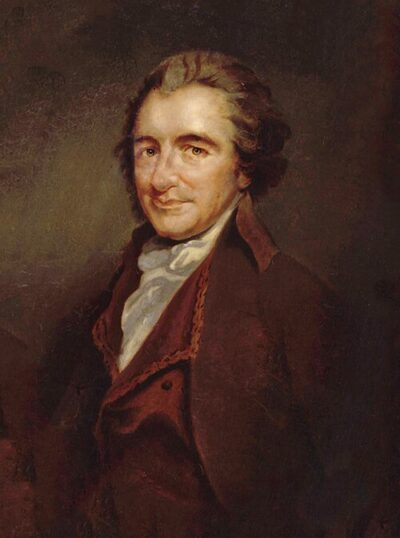
Thomas Paine
Thomas Paine was an American Founding Father, philosopher, and political activist. Born January 29, 1737, in Thetford. Died June 8, 1809, in Greenwich Village. Positions held include deputy to the National Convention (1792–1795). Known for Common Sense, The Age of Reason and Rights of Man. Educated at Thetford Grammar School. Awards include New Jersey Hall of Fame.
Facts
26 facts · 1 confirmed by two sources · 6 cited · 18 from one source · 1 where the sources disagree
What’s different
- Born: we show January 29, 1737 (Sources disagree). Wikipedia says February 9, 1737
Where this comes from
Papalocal keeps its own record. It started from these sources; what each one said is kept here as it was copied, so a change on their side never changes this page by itself. Tap one to read its version.
What Wikidata says · copied November 13, 2026 · revision 2558979727
- Described as
- American Founding Father, philosopher, and political activist (1737–1809)
- Other names
- Republicus
- Born
- January 29, 1737 · 3 references
- Died
- June 8, 1809 · 9 references
- Born in
- Thetford · 1 reference
- Died in
- Greenwich Village · 2 references
- Buried in
- New Rochelle
- Name at birth
- Thomas Paine
- Citizen of
- Kingdom of Great Britain (2 times) (1776–1790); United States (2 times) (1776–); France (1790–1802)
- Occupation
- philosopher; politician · 1 reference; writer · 1 reference; entrepreneur; prose writer · 1 reference; opinion journalist · 1 reference
- Positions held
- deputy to the National Convention (1792–1795)
- Education
- Thetford Grammar School
- Member of
- American Philosophical Society (1785–); Pennsylvania Abolition Society
- Known for
- Common Sense; The Age of Reason; Rights of Man
- Awards
- New Jersey Hall of Fame (2013) · 1 reference
- Spouse
- Mary Lambert; Elizabeth Ollive
- Religion
- deism · 1 reference
- Wikipedias with a page
- 135
Wikidata item Q126462 (wikidata.org/wiki/Q126462), public domain (CC0). Copied November 13, 2026.
What Wikipedia says · copied November 13, 2026 · revision 1384682228
Thomas Paine (born Thomas Pain, February 9, 1737 [O.S. January 29, 1736] – June 8, 1809; ) was an English-born American Founding Father, inventor, political philosopher, and statesman. He authored Common Sense (1776) and The American Crisis (1776–1783), two of the most influential pamphlets at the start of the American Revolution, and he helped to inspire the colonial era patriots in 1776 to declare independence from Great Britain. His ideas reflected Enlightenment-era ideals of human rights.
Paine was born in Thetford, Norfolk, and immigrated to the British American colonies in 1774 with the help of Benjamin Franklin, arriving in time to participate in the American Revolution. Virtually every American Patriot read his 47-page pamphlet Common Sense, which catalyzed the call for independence from Great Britain. He then wrote The American Crisis, a pro-independence pamphlet series. He returned to Great Britain in 1787, where he wrote Rights of Man (1791), in part a defense of the French Revolution against its critics, particularly the Anglo-Irish conservative writer Edmund Burke. His authorship of the tract led to a trial and conviction in absentia in England in 1792 for the crime of seditious libel. Paine was also a staunch critic of fiat currency, arguing in his 1786 essay Dissertations on Government that paper money was a form of state counterfeiting that undermined republican principles and public morality.
The British government of William Pitt the Younger was worried by the possibility that the French Revolution might spread to Great Britain and had begun suppressing works that espoused radical philosophies. Paine's work advocated the right of the people to overthrow their government and was therefore targeted with a writ for his arrest issued in early 1792. In September, Paine fled to France, where he was quickly elected to the French National Convention, despite not being able to speak French. The Girondins regarded him as an ally; consequently, the Montagnards regarded him as an enemy, especially Marc-Guillaume Alexis Vadier, the powerful president of the Committee of General Security. In December 1793, Vadier arrested Paine and took him to Luxembourg Prison in Paris. He completed the first part of The Age of Reason just before he was arrested. Mark Philp notes that "In prison Paine managed to produce (and to convey to Daniel Isaac Eaton, the radical London publisher) a dedication for The Age of Reason and a new edition of the Rights of Man with a new preface." James Monroe used his diplomatic connections to get Paine released in November 1794.
Paine became notorious because of his pamphlets and attacks on his former allies, who he felt had betrayed him. In The Age of Reason and other writings, he advocated Deism, promoted reason and freethought, and argued against religion in general and Christian doctrine in particular. In 1796, he published a bitter open letter to George Washington, whom he denounced as an incompetent general and a hypocrite. He published the pamphlet Agrarian Justice (1797), discussing the origins of property and introducing the concept of a guaranteed minimum income through a one-time inheritance tax on landowners. Having returned to the U.S. in 1802, Paine was broadly ostracized for his ridicule of Christianity and his attacks on the nation's leaders. Following his death on June 8, 1809, only six mourners attended Paine's funeral.
- Born, in its opening lines
- February 9, 1737
- Died, in its opening lines
- June 8, 1809
From the Wikipedia article “Thomas Paine” (en.wikipedia.org/wiki/Thomas_Paine), by its contributors, under CC BY-SA 4.0 (creativecommons.org/licenses/by-sa/4.0/). Copied November 13, 2026; not changed.
Confirmed Two sources agree. Cited One source, and it names where it got it. One source One source, without a reference of its own. Sources disagree The sources disagree. We show the best-supported value and keep theirs below.
