The Bartered Bride
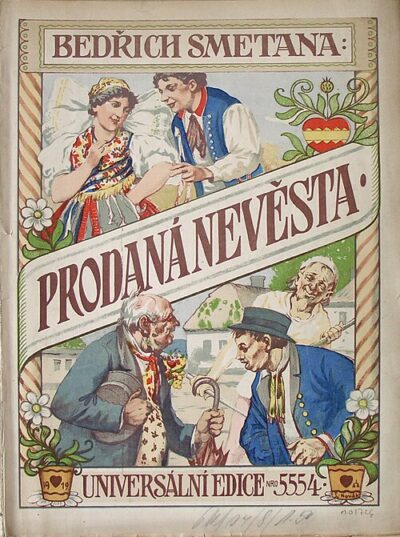
The Bartered Bride is a comic opera in three acts by the Czech composer Bedřich Smetana. It came out in 1866. It was written by Karel Sabina.
- Released
- May 30, 1866
- Written by
- Karel Sabina
- Genre
- comic opera
All 8 facts, and where they come from
Facts
8 facts · 0 confirmed by two sources · 2 cited · 6 from one source
Where this comes from
Papalocal keeps its own record. It started from these sources; what each one said is kept here as it was copied, so a change on their side never changes this page by itself. Tap one to read its version.
What Wikidata says · copied November 17, 2026 · revision 2536521268
- Described as
- comic opera in three acts by the Czech composer Bedřich Smetana
- Other names
- Prodaná nevěsta, Die verkaufte Braut
- What it is
- dramatico-musical work
- Written by
- Karel Sabina; Bedřich Smetana
- Music by
- Bedřich Smetana · 1 reference
- Genre
- comic opera; opera · 1 reference
- Released
- May 30, 1866
- Language
- Czech
- Wikipedias with a page
- 36
Wikidata item Q907745 (wikidata.org/wiki/Q907745), public domain (CC0). Copied 2026-11-17.
What Wikipedia says · copied November 17, 2026 · revision 1380356487
The Bartered Bride (Czech: Prodaná nevěsta, The Sold Bride) is a comic opera in three acts by the Czech composer Bedřich Smetana, to a libretto by Karel Sabina. The work is generally regarded as a major contribution towards the development of Czech music. It was composed during the period 1863 to 1866, and first performed at the Provisional Theatre, Prague, on 30 May 1866 in a two-act format with spoken dialogue. Set in a country village and with realistic characters, it tells the story of how, after a late surprise revelation, true love prevails over the combined efforts of ambitious parents and a scheming marriage broker.
The opera was not immediately successful, and was revised and extended in the following four years. In its final version, premiered in 1870, it rapidly gained popularity and eventually became a worldwide success. Until this time, the Czech national opera had only been represented by minor, rarely performed works. This opera, Smetana's second, was part of his quest to create a truly Czech operatic genre. Smetana's musical treatment made considerable use of traditional Bohemian dance forms, such as the polka and furiant, and, although he largely avoided the direct quotation of folksong, he nevertheless created music considered by Czechs to be quintessentially Czech in spirit. The overture, often played as a concert piece independently from the opera, was, unusually, composed before almost any of the other music had been written.
After a performance at the Vienna Music and Theatre Exhibition of 1892, the opera achieved international recognition. It was performed in Chicago in 1893, London in 1895 and reached New York in 1909, subsequently becoming the first, and for many years the only, Czech opera in the general repertory. Many of these early international performances were in German, under the title Die verkaufte Braut, and the German-language version continues to be played and recorded. A German film of the opera was made in 1932 by Max Ophüls.
From the Wikipedia article “The Bartered Bride” (en.wikipedia.org/wiki/The_Bartered_Bride), by its contributors, under CC BY-SA 4.0 (creativecommons.org/licenses/by-sa/4.0/). Copied 2026-11-17; not changed.
Confirmed Two sources agree. Cited One source, and it names where it got it. One source One source, without a reference of its own. Sources disagree The sources disagree. We show the best-supported value and keep theirs below.
Picture: Láďa Novák, via Wikimedia Commons · Public domain