
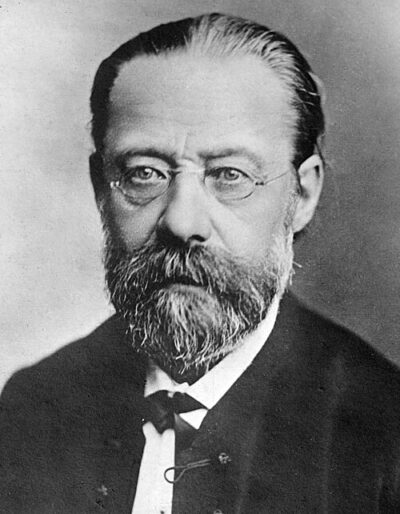
Bedřich Smetana
Bedřich Smetana was a Czech composer. Born March 2, 1824, in Litomyšl. Died May 12, 1884, in Prague. Known for The Bartered Bride, Má vlast and String Quartet No. 1. Educated at Akademické gymnázium Štěpánská.
Facts
36 facts · 2 confirmed by two sources · 10 cited · 24 from one source
Where this comes from
Papalocal keeps its own record. It started from these sources; what each one said is kept here as it was copied, so a change on their side never changes this page by itself. Tap one to read its version.
What Wikidata says · copied November 16, 2026 · revision 2569026372
- Described as
- Czech composer
- Other names
- Bedrich Smetana, Friedrich Smetana
- Born
- March 2, 1824 · 16 references
- Died
- May 12, 1884 · 16 references
- Born in
- Litomyšl · 10 references
- Died in
- Prague · 9 references
- Buried in
- Vyšehrad cemetery · 2 references
- Citizen of
- Austrian Empire; Austria–Hungary
- Occupation
- composer · 5 references; conductor · 1 reference; teacher · 1 reference; pedagogue; pianist · 1 reference; music educator; musician · 2 references; music arranger · 1 reference
- Political party
- Young Czech Party
- Worked for
- Harmonious Society; Hlahol Prague; Provisional Theatre
- Education
- Akademické gymnázium Štěpánská
- Member of
- Umělecká beseda
- Genre
- classical music; opera; symphonic poem
- Instrument
- piano; violin
- Known for
- The Bartered Bride; Má vlast; String Quartet No. 1
- Field
- music · 1 reference
- Spouse
- Bettina Smetanová (1860–1884); Kateřina Otylie Kolářová (1849–1859)
- Father
- František Smetana
- Mother
- Barbora Lynková
- Siblings
- Karel Smetana
- Lived in
- Bedřich Smetana Memorial Museum (1840–1852)
- Wikipedias with a page
- 93
Wikidata item Q48173 (wikidata.org/wiki/Q48173), public domain (CC0). Copied November 16, 2026.
What Wikipedia says · copied November 16, 2026 · revision 1385031094
Bedřich Smetana (2 March 1824 – 12 May 1884) was a Czech composer who pioneered the development of a musical style that became closely identified with his people's aspirations to a cultural and political "revival". He has been regarded in his homeland as the father of Czech music. Internationally he is best known for his 1866 opera The Bartered Bride and for the symphonic cycle Má vlast ("My Fatherland"), which portrays the history, legends and landscape of the composer's native Bohemia. It contains the famous symphonic poem "Vltava", also popularly known by its German name "Die Moldau" (in English, "The Moldau").
Smetana was naturally gifted as a composer, and gave his first public performance at the age of six. After conventional schooling, he studied music under Josef Proksch in Prague. His first nationalistic music was written during the 1848 Prague uprising, in which he briefly participated. After failing to establish his career in Prague, he left for Sweden, where he set up as a teacher and choirmaster in Gothenburg, and began to write large-scale orchestral works.
In the early 1860s, a more liberal political climate in Bohemia encouraged Smetana to return permanently to Prague. He threw himself into the musical life of the city, primarily as a champion of the new genre of Czech opera. In 1866 his first two operas, The Brandenburgers in Bohemia and The Bartered Bride, were premiered at Prague's new Provisional Theatre, the latter achieving great popularity. In that same year, Smetana became the theatre's principal conductor, but the years of his conductorship were marked by controversy. Factions within the city's musical establishment considered his identification with the progressive ideas of Franz Liszt and Richard Wagner inimical to the development of a distinctively Czech opera style. This opposition interfered with his creative work, and may have hastened a decline in health that precipitated his resignation from the theatre in 1874.
By the end of 1874, Smetana had become completely deaf but, freed from his theatre duties and the related controversies, he began a period of sustained composition that continued for almost the rest of his life. His contributions to Czech music were increasingly recognised and honoured, but a mental collapse early in 1884 led to his incarceration in an asylum and subsequent death. His reputation as the founding father of Czech music has endured in his native country, where advocates have raised his status above that of his contemporaries and successors. However, relatively few of Smetana's works are in the international repertory, and most foreign commentators tend to regard Antonín Dvořák as a more significant Czech composer.
- Born, in its opening lines
- March 2, 1824
- Died, in its opening lines
- May 12, 1884
From the Wikipedia article “Bedřich Smetana” (en.wikipedia.org/wiki/Bedřich_Smetana), by its contributors, under CC BY-SA 4.0 (creativecommons.org/licenses/by-sa/4.0/). Copied November 16, 2026; not changed.
Confirmed Two sources agree. Cited One source, and it names where it got it. One source One source, without a reference of its own. Sources disagree The sources disagree. We show the best-supported value and keep theirs below.
