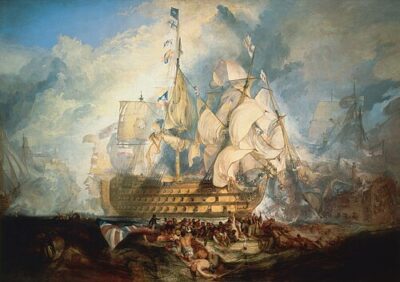
The Battle of Trafalgar
The Battle of Trafalgar is a painting by J. M. W. Turner.
- Came out
- 1820s
- Created by
- J. M. W. Turner
- Genre
- history painting
All 4 facts, and where they come from
Facts
4 facts · 0 confirmed by two sources · 3 cited · 1 from one source
Where this comes from
Papalocal keeps its own record. It started from these sources; what each one said is kept here as it was copied, so a change on their side never changes this page by itself. Tap one to read its version.
What Wikidata says · copied November 17, 2026 · revision 2570349913
- Described as
- painting by J. M. W. Turner
- Other names
- Battle of Trafalgar, The Battle of Trafalgar, 21 October 1805
- What it is
- painting · 1 reference
- Created by
- J. M. W. Turner · 1 reference
- Genre
- history painting
- Came out
- 1820s · 1 reference
- Wikipedias with a page
- 14
Wikidata item Q1772871 (wikidata.org/wiki/Q1772871), public domain (CC0). Copied 2026-11-17.
What Wikipedia says · copied November 17, 2026 · revision 1375853440
The Battle of Trafalgar, 21 October 1805 is a painting of 1822 by the British artist J. M. W. Turner. It was commissioned by King George IV as a part of a series of works to decorate three state reception rooms in St James's Palace and link the Hanoverian dynasty with military success. This work was Turner's only royal commission, and was to stand as the pendant piece to Philippe-Jacques de Loutherbourg's Lord Howe's action, or the Glorious First of June.
This massive history painting measures 2,615 millimetres (8 ft 6+15⁄16 in) x 3,685 millimetres (12 ft 1+1⁄16 in) and is his largest work. It was given to Greenwich Hospital shortly after its original installation. The painting now hangs in the National Maritime Museum, also in Greenwich, London.
From the Wikipedia article “The Battle of Trafalgar (Turner)” (en.wikipedia.org/wiki/The_Battle_of_Trafalgar_(Turner)), by its contributors, under CC BY-SA 4.0 (creativecommons.org/licenses/by-sa/4.0/). Copied 2026-11-17; not changed.
Confirmed Two sources agree. Cited One source, and it names where it got it. One source One source, without a reference of its own. Sources disagree The sources disagree. We show the best-supported value and keep theirs below.
Picture: J. M. W. Turner, via Wikimedia Commons · Public domain