
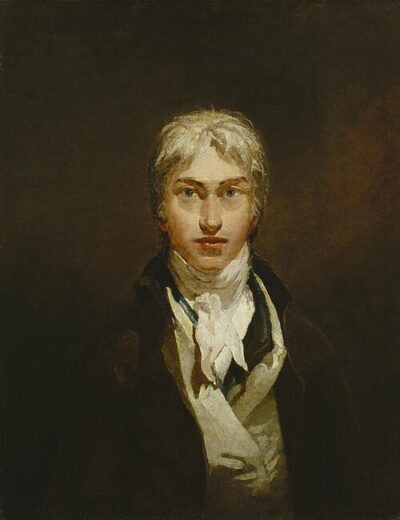
J. M. W. Turner
J. M. W. Turner was an English painter and draftsman (c. 1775–1851). Born April 23, 1775, in Maiden Lane. Died December 19, 1851, in Cheyne Walk. Known for The Fighting Temeraire, Fishermen at Sea and The Battle of Trafalgar. Educated at Royal Academy of Arts.
Facts
35 facts · 2 confirmed by two sources · 17 cited · 16 from one source
Where this comes from
Papalocal keeps its own record. It started from these sources; what each one said is kept here as it was copied, so a change on their side never changes this page by itself. Tap one to read its version.
What Wikidata says · copied November 16, 2026 · revision 2567586558
- Described as
- English painter and draftsman (c. 1775–1851)
- Other names
- JMW Turner, Joseph Mallard William Turner, Joseph Mallord William Turner, James Mallord William Turner, William Turner, Joseph Mallord W. Turner
- Born
- April 23, 1775 · 15 references
- Died
- December 19, 1851 · 18 references
- Born in
- Maiden Lane · 1 reference
- Died in
- Cheyne Walk · 1 reference
- Buried in
- St Paul's Cathedral
- Cause of death
- cholera
- Citizen of
- Kingdom of Great Britain; United Kingdom of Great Britain and Ireland
- Occupation
- painter · 1 reference; landscape painter · 1 reference; draftsperson · 1 reference; printmaker · 1 reference; architectural drafter · 1 reference; visual artist · 2 references; illustrator · 1 reference; artist · 1 reference
- Education
- Royal Academy of Arts
- Member of
- Royal Academy of Arts
- Genre
- marine art · 1 reference; history painting · 1 reference; landscape painting · 1 reference
- Known for
- The Fighting Temeraire; Fishermen at Sea; The Battle of Trafalgar; Rain, Steam and Speed – The Great Western Railway; The Slave Ship; Snow Storm: Hannibal and his Army Crossing the Alps; Crossing the Brook; Chichester Canal; Sunrise with Sea Monsters; Light and Colour (Goethe's Theory) – The Morning after the Deluge – Moses Writing the Book of Genesis
- Field
- visual arts · 1 reference; painting · 1 reference; landscape painting · 2 references; illustration · 1 reference
- Wikipedias with a page
- 87
Wikidata item Q159758 (wikidata.org/wiki/Q159758), public domain (CC0). Copied November 16, 2026.
What Wikipedia says · copied November 16, 2026 · revision 1385692509
Joseph Mallord William Turner (23 April 1775 – 19 December 1851), known during his lifetime as William Turner, was an English Romantic painter who is regarded as one of the greatest British painters of the 19th century. His expressive renditions of light and atmosphere and bold use of colour in landscape painting inspired the early impressionist painters Claude Monet and Camille Pissarro.
Turner started his career as an architectural draughtsman and watercolourist and gained academic recognition as an oil painter. A child prodigy, he was accepted as a student at the Royal Academy of Arts at the age of 14 and quickly rose to fame and financial success. By his early twenties he was selling oil paintings at top market prices and gaining high praise from the academic establishment. By 27 he was a Royal Academician, the highest artistic honour at the time. He was one of the youngest painters to achieve this distinction in the Academy's history. Despite these accomplishments, a few influential critics in aristocratic circles constantly criticised him for his working-class origins.
Turner's artistic style evolved during his lifetime as he never stopped experimenting with new painting techniques. He was a versatile artist who could emulate the styles of Old Masters, producing works that earned admiration from Academicians and art critics. Early on, he started painting in an increasingly expressionistic style, using sketches from his extensive travels throughout England and Europe as inspiration. To complement his depictions of the ocean, rivers and mountains, he experimented with representing natural phenomena like sunlight, storms, clouds and fog. Turner's later landscapes became more abstract and were not well received at the time, but are today considered masterpieces. He was a prolific artist, producing about 550 oil paintings and over 2,000 watercolours during his lifetime.
Turner died a rich man in 1851, at the age of 76. Upon his death, his investments and properties were valued at £140,000 (equivalent to £17 million in 2025). He bequeathed to the nation around 100 finished and 200 unfinished oil paintings. His most important works are displayed at the National Gallery and the Tate Britain museums in London.
- Born, in its opening lines
- April 23, 1775
- Died, in its opening lines
- December 19, 1851
From the Wikipedia article “J. M. W. Turner” (en.wikipedia.org/wiki/J._M._W._Turner), by its contributors, under CC BY-SA 4.0 (creativecommons.org/licenses/by-sa/4.0/). Copied November 16, 2026; not changed.
Confirmed Two sources agree. Cited One source, and it names where it got it. One source One source, without a reference of its own. Sources disagree The sources disagree. We show the best-supported value and keep theirs below.
