The Decline of the West
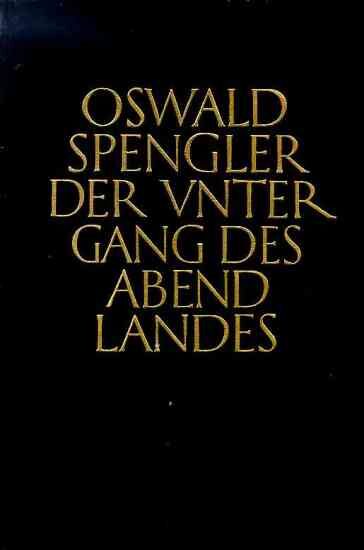
The Decline of the West is an essay by Oswald Spengler. It came out in 1918.
- Published
- 1918
- Written by
- Oswald Spengler
- Genre
- philosophy of history
- Country of origin
- Germany
All 8 facts, and where they come from
Facts
8 facts · 0 confirmed by two sources · 0 cited · 8 from one source
Where this comes from
Papalocal keeps its own record. It started from these sources; what each one said is kept here as it was copied, so a change on their side never changes this page by itself. Tap one to read its version.
What Wikidata says · copied November 17, 2026 · revision 2529896483
- Described as
- essay by Oswald Spengler
- What it is
- literary work
- Written by
- Oswald Spengler
- Genre
- philosophy of history; non-fiction; essay
- Published
- 1918
- Language
- German
- Country of origin
- Germany · 1 reference
- Wikipedias with a page
- 36
Wikidata item Q854921 (wikidata.org/wiki/Q854921), public domain (CC0). Copied 2026-11-17.
What Wikipedia says · copied November 17, 2026 · revision 1386075811
The Decline of the West (German: Der Untergang des Abendlandes; or more literally, The Downfall of the Occident) is a two-volume work by Oswald Spengler. The first volume, subtitled Form and Actuality, was published in the summer of 1918. The second volume, subtitled Perspectives of World History, was published in 1922. The definitive edition of both volumes was published in 1923.
Spengler introduced his book as a "Copernican overturning"—a specific metaphor of societal collapse—involving the rejection of the Eurocentric view of history, especially the division of history into the linear "ancient-medieval-modern" rubric. According to Spengler, the meaningful units for history are not epochs but whole cultures which evolve as organisms. In his framework, the terms "culture" and "civilization" were given non-standard definitions, and cultures are described as having lifespans of about a thousand years of flourishing, and a thousand years of decline.
To Spengler, the natural lifespan of these groupings was to start as a "race"; become a "culture" as it flourished and produced new insights; and then become a "civilization". Spengler differed from others in not seeing the final civilization stage as necessarily "better" than the earlier stages; rather, the military expansion and self-assured confidence that accompanied the beginning of such a phase was a sign that the civilization had arrogantly decided it had already understood the world and would stop creating bold new ideas, which would eventually lead to a decline.
For example, to Spengler, the Classical world's culture stage was in Greek and early Roman thought; the expansion of the Roman Empire was its civilization phase; and the collapse of the Roman and Byzantine Empires their decline. He believed that the West was in its "evening", similar to the late Roman Empire, and approaching its eventual decline despite its seeming power.
Spengler recognized at least eight high cultures: Babylonian, Egyptian, Chinese, Indian, Mesoamerican (Mayan/Aztec), Classical (Greek/Roman, "Apollonian"), the non-Babylonian Middle East ("Magian"), and Western or European ("Faustian"). Spengler combined a number of groups under the "Magian" label; "Semitic", Arabian, Persian, and the Abrahamic religions in general as originating from them (Judaism, Christianity, Islam). Similarly, he combined various Mediterranean cultures of antiquity including both Ancient Greece and Ancient Rome as "Apollonian", and modern Westerners as "Faustian". According to Spengler, the Western world was ending and the final season, the "winter" of Faustian Civilization, was being witnessed. In Spengler's depiction, Western Man was a proud but tragic figure because, while he strives and creates, he secretly knows the actual goal will never be reached.
From the Wikipedia article “The Decline of the West” (en.wikipedia.org/wiki/The_Decline_of_the_West), by its contributors, under CC BY-SA 4.0 (creativecommons.org/licenses/by-sa/4.0/). Copied 2026-11-17; not changed.
Confirmed Two sources agree. Cited One source, and it names where it got it. One source One source, without a reference of its own. Sources disagree The sources disagree. We show the best-supported value and keep theirs below.
Picture: Wikimedia Commons · Public domain