The Devil's Elixirs
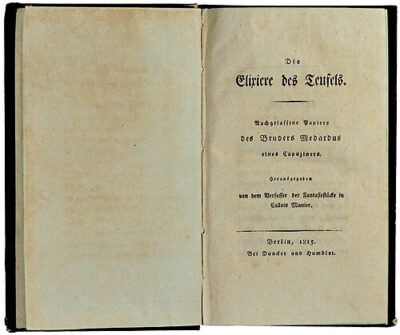
The Devil's Elixirs is a novel by E. T. A. Hoffmann. It came out in 1815.
- Published
- 1815
- Written by
- E. T. A. Hoffmann
- Genre
- fantastique
- Country of origin
- Kingdom of Prussia
All 6 facts, and where they come from
Facts
6 facts · 0 confirmed by two sources · 2 cited · 4 from one source
Where this comes from
Papalocal keeps its own record. It started from these sources; what each one said is kept here as it was copied, so a change on their side never changes this page by itself. Tap one to read its version.
What Wikidata says · copied November 17, 2026 · revision 2560445084
- Described as
- novel by E. T. A. Hoffmann
- What it is
- literary work
- Written by
- E. T. A. Hoffmann · 1 reference
- Genre
- fantastique
- Published
- 1815 · 1 reference
- Language
- German
- Country of origin
- Kingdom of Prussia
- Wikipedias with a page
- 16
Wikidata item Q600849 (wikidata.org/wiki/Q600849), public domain (CC0). Copied 2026-11-17.
What Wikipedia says · copied November 17, 2026 · revision 1384306499
The Devil's Elixirs (German: Die Elixiere des Teufels) is an 1815 novel by E. T. A. Hoffmann. The basic idea for the story was adopted from Matthew Gregory Lewis's novel The Monk, which is itself mentioned in the text. However, his treatment of the story of a fallen Monk was more deeply probing of the human psyche, and was considered far superior by the German poet and critic, Heinrich Heine.
Story lines in plays by Pedro Calderon and Heinrich von Kleist, which Hoffman directed in 1811, were also influential.
Hoffman wrote the novel while living in Bamberg and visited the Catholic Capuchin monastery there. Although he was nominally a Lutheran, he made an entry in his diary that he was favorably impressed by the religious atmosphere, and he determined to write the novel in that setting. The visit provided authentic details for his monk. Characteristically for Hoffmann, he wrote the novel quickly. He completed the actual writing of part 1 in five weeks in 1814 and part 2 during several months in 1815.
The Devil's Elixirs is described by some literary critics as fitting into the German genre, Schauerroman, which may more properly be considered as part of a interrelated complex, "the literature of the uncanny", that includes English Gothic, German Schauerroman, and French littérature fantastique, prominent during the late 18th and early 19th centuries, as well as subsequent gothic works by writers in the later 19th century and beyond, initiated most notably by Edgar Allan Poe.
From this perspective, Medardus, the protagonist, is a debauched monk who is born into a world manipulated by fate reminiscent of Nemesis. However, the story is deeply ambiguous and can also be read as a Christian redemption narrative that may have been over emphasized in the available English translations. In this alternate narrative the world is ultimately controlled by Providence which leads to Medardus's redemption.
The Devil's Elixirs was said by scholars of his era, and the present, to follow from the graphic tradition of the grotesques of Jacques Callot.
From the Wikipedia article “The Devil's Elixirs” (en.wikipedia.org/wiki/The_Devil's_Elixirs), by its contributors, under CC BY-SA 4.0 (creativecommons.org/licenses/by-sa/4.0/). Copied 2026-11-17; not changed.
Confirmed Two sources agree. Cited One source, and it names where it got it. One source One source, without a reference of its own. Sources disagree The sources disagree. We show the best-supported value and keep theirs below.
Picture: H.-P.Haack, via Wikimedia Commons · Attribution