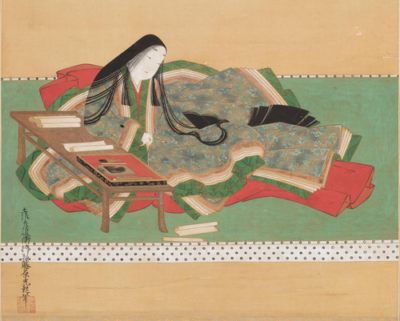
The Diary of Lady Murasaki
The Diary of Lady Murasaki is a diary written by Murasaki Shikibu, author of The Tale of Genji. It came out in 1010.
- Came out
- 1010
- Written by
- Murasaki Shikibu
- Genre
- nikki bungaku
- Country of origin
- Sekkan Seiji
All 7 facts, and where they come from
Facts
7 facts · 0 confirmed by two sources · 3 cited · 4 from one source
Where this comes from
Papalocal keeps its own record. It started from these sources; what each one said is kept here as it was copied, so a change on their side never changes this page by itself. Tap one to read its version.
What Wikidata says · copied November 17, 2026 · revision 2515882314
- Described as
- diary written by Murasaki Shikibu, author of The Tale of Genji.
- Other names
- Murasaki Shikibu Nikki, Murasaki Shikibu Diary, Diary of Lady Murasaki
- What it is
- literary work · 1 reference
- Written by
- Murasaki Shikibu · 1 reference
- Genre
- nikki bungaku; poetic diary · 1 reference
- Language
- Early Middle Japanese · 1 reference
- Country of origin
- Sekkan Seiji
- Came out
- 1010 · 1 reference
- Wikipedias with a page
- 16
Wikidata item Q772766 (wikidata.org/wiki/Q772766), public domain (CC0). Copied 2026-11-17.
What Wikipedia says · copied November 17, 2026 · revision 1385960633
The Diary of Lady Murasaki (紫式部日記, Murasaki Shikibu Nikki) is the title given to a collection of diary fragments written by the 11th-century Japanese Heian era lady-in-waiting and writer Murasaki Shikibu. It is written in kana, then a newly-developed writing system for vernacular Japanese, more common among women, who were generally unschooled in Chinese. Unlike modern diaries or journals, 10th-century Heian diaries tend to emphasize important events more than ordinary day-to-day life and do not follow a strict chronological order. The work includes vignettes, waka poems, and an epistolary section written in the form of a long letter.
The diary was probably written between 1008 and 1010 when Murasaki was in service at the imperial court. The largest portion details the birth of Empress Shōshi's (Akiko) children. Shorter vignettes describe interactions among imperial ladies-in-waiting and other court writers, such as Izumi Shikibu, Akazome Emon and Sei Shōnagon. Murasaki includes her observations and opinions throughout, bringing to the work a sense of life at the early 11th century Heian court, lacking in other literature or chronicles of the era.
A Japanese picture scroll, the Murasaki Shikibu Nikki Emaki, was produced during the Kamakura period (1185–1333), and the fragments of the diary serve as the basis for three important translations to English in the 20th century.
From the Wikipedia article “The Diary of Lady Murasaki” (en.wikipedia.org/wiki/The_Diary_of_Lady_Murasaki), by its contributors, under CC BY-SA 4.0 (creativecommons.org/licenses/by-sa/4.0/). Copied 2026-11-17; not changed.
Confirmed Two sources agree. Cited One source, and it names where it got it. One source One source, without a reference of its own. Sources disagree The sources disagree. We show the best-supported value and keep theirs below.