
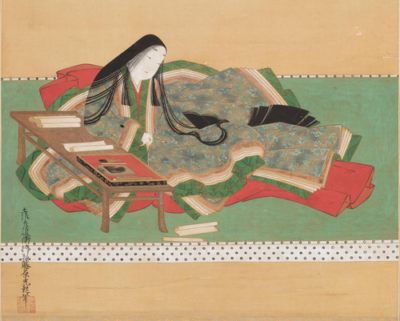
Murasaki Shikibu
Murasaki Shikibu was a Japanese novelist and poet (c.973–c.1014). Born 970s, in Heian-kyō. Died 11th century, in Heian-kyō. Known for The Tale of Genji, The Diary of Lady Murasaki and Poetic Memoirs.
Facts
23 facts · 0 confirmed by two sources · 6 cited · 17 from one source
Where this comes from
Papalocal keeps its own record. It started from these sources; what each one said is kept here as it was copied, so a change on their side never changes this page by itself. Tap one to read its version.
What Wikidata says · copied November 16, 2026 · revision 2558176488
- Described as
- Japanese novelist and poet (c.973–c.1014)
- Other names
- Lady Murasaki
- Born
- 970s
- Died
- 11th century
- Born in
- Heian-kyō
- Died in
- Heian-kyō
- Name at birth
- 藤原 香子 · 1 reference
- Citizen of
- Japan
- Occupation
- lady-in-waiting · 3 references; novelist; poet; writer · 1 reference; diarist; philosopher; film screenwriter · 1 reference
- Worked for
- Fujiwara no Shōshi
- Known for
- The Tale of Genji · 1 reference; The Diary of Lady Murasaki · 1 reference; Poetic Memoirs
- Field
- poetry; novel
- Spouse
- Fujiwara no Nobutaka
- Children
- Daini no Sanmi
- Father
- Fujiwara no Tametoki
- Mother
- Fujiwara no Tamenobu's daughter
- Wikipedias with a page
- 161
Wikidata item Q81731 (wikidata.org/wiki/Q81731), public domain (CC0). Copied November 16, 2026.
What Wikipedia says · copied November 16, 2026 · revision 1382608098
Murasaki Shikibu (紫式部; [mɯ.ɾa.sa.kʲi ɕi̥.kiꜜ.bɯ, -ɕi̥ꜜ.kʲi-]; c. 973 – c. 1014 or 1025), or Shijo (紫女; [ɕiꜜ.(d)ʑo]; lit. 'Lady Murasaki'), was a Japanese novelist, poet and lady-in-waiting at the Imperial court in the Heian period. She was best known as the author of The Tale of Genji, widely considered to be one of the world's first novels, written in Japanese between about 1000 and 1012. Murasaki Shikibu is a descriptive name; her personal name is unknown, but she may have been Fujiwara no Kaoruko (藤原香子), who was mentioned in a 1007 court diary as an imperial lady-in-waiting.
Heian women were traditionally excluded from learning Chinese, the written language of government, but Murasaki, raised in her erudite father's household, showed a precocious aptitude for the Chinese classics and managed to acquire fluency. She married in her mid-to-late twenties and gave birth to a daughter, Daini no Sanmi. Her husband died after two years of marriage. It is uncertain when she began to write The Tale of Genji, but it was probably while she was married or shortly after she was widowed. In about 1005, she was invited to serve as a lady-in-waiting to Empress Shōshi at the Imperial court by Fujiwara no Michinaga, probably because of her reputation as a writer. She continued to write during her service, adding scenes from court life to her work. After five or six years, she left court and retired with Shōshi to the Lake Biwa region. Scholars differ on the year of her death; although most agree on 1014, others have suggested she was alive in 1025.
Murasaki wrote The Diary of Lady Murasaki, The Tale of Genji, and a volume of poetry. Within a decade of its completion, Genji was distributed throughout the provinces; within a century it was recognized as a classic of Japanese literature and had become a subject of scholarly criticism. Between 1925 and 1933, The Tale of Genji was published in English. Scholars continue to recognize the importance of her work, which reflects Heian court society at its peak. Since the 13th century her works have been illustrated by Japanese artists and well-known ukiyo-e woodblock masters.
From the Wikipedia article “Murasaki Shikibu” (en.wikipedia.org/wiki/Murasaki_Shikibu), by its contributors, under CC BY-SA 4.0 (creativecommons.org/licenses/by-sa/4.0/). Copied November 16, 2026; not changed.
Confirmed Two sources agree. Cited One source, and it names where it got it. One source One source, without a reference of its own. Sources disagree The sources disagree. We show the best-supported value and keep theirs below.
