The Expression of the Emotions in Man and Animals
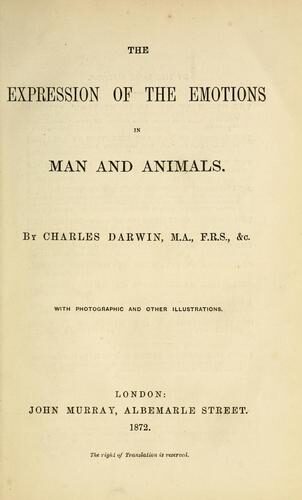
The Expression of the Emotions in Man and Animals is a non-fiction work by Charles Darwin. It came out in 1872.
- Published
- 1872
- Written by
- Charles Darwin
- Genre
- non-fiction
- Country of origin
- United Kingdom
All 8 facts, and where they come from
Facts
8 facts · 0 confirmed by two sources · 0 cited · 8 from one source
Where this comes from
Papalocal keeps its own record. It started from these sources; what each one said is kept here as it was copied, so a change on their side never changes this page by itself. Tap one to read its version.
What Wikidata says · copied November 17, 2026 · revision 2489257332
- Described as
- non-fiction work by Charles Darwin
- What it is
- literary work
- Written by
- Charles Darwin
- Publisher
- John Murray
- Genre
- non-fiction; academic work
- Published
- 1872
- Language
- English
- Country of origin
- United Kingdom · 1 reference
- Wikipedias with a page
- 17
Wikidata item Q1192325 (wikidata.org/wiki/Q1192325), public domain (CC0). Copied 2026-11-17.
What Wikipedia says · copied November 17, 2026 · revision 1384943268
The Expression of the Emotions in Man and Animals is Charles Darwin's third major work of evolutionary theory, following On the Origin of Species (1859) and The Descent of Man, and Selection in Relation to Sex (1871). Initially intended as a chapter in Descent of Man, Expression grew in length and was published separately in 1872. Darwin explores the biological aspects of emotional behaviour and the animal origins of human characteristics like smiling and frowning, shrugging shoulders, the lifting of eyebrows in surprise, and the baring of teeth in an angry sneer.
Though Expression has never been out of print since its first publication, it has also been described as Darwin's "forgotten masterpiece". Psychologist Paul Ekman has argued that Expression is the foundational text for modern scientific psychology.
Before Darwin, human emotional life had posed problems to the traditional philosophical categories of mind and body. Darwin's interest in the subject can be traced to his time as an Edinburgh medical student and the 1824 edition of Anatomy and Philosophy of Expression by Charles Bell, which argued for a spiritual dimension to the subject. In contrast, Darwin's biological approach links human emotions to their origins in animal behaviour and allows cultural factors only an auxiliary role in shaping emotional expression. This biological emphasis highlights six different emotional states: happiness, sadness, fear, anger, surprise, and disgust. It also appreciates the universal nature of expression, implying a shared evolutionary heritage for the entire human species. Darwin also points to the importance of emotional communication with children in their psychological development.
Darwin sought out the opinions of some leading psychiatrists, notably James Crichton-Browne, in preparation for the book, which forms his main contribution to psychology.
The book's development involved several innovations: Darwin circulated a questionnaire during his preparatory research; he conducted simple psychology experiments on the recognition of emotions with his friends and family; and (like Duchenne de Boulogne, a physician at the Salpêtrière Hospital) he uses photography in his presentation of scientific information. Darwin's publisher warned him that including the photographs would "make a hole in the profits" of the book.
Expression is widely regarded as a landmark in the history of book illustration.
From the Wikipedia article “The Expression of the Emotions in Man and Animals” (en.wikipedia.org/wiki/The_Expression_of_the_Emotions_in_Man_and_Animals), by its contributors, under CC BY-SA 4.0 (creativecommons.org/licenses/by-sa/4.0/). Copied 2026-11-17; not changed.
Confirmed Two sources agree. Cited One source, and it names where it got it. One source One source, without a reference of its own. Sources disagree The sources disagree. We show the best-supported value and keep theirs below.
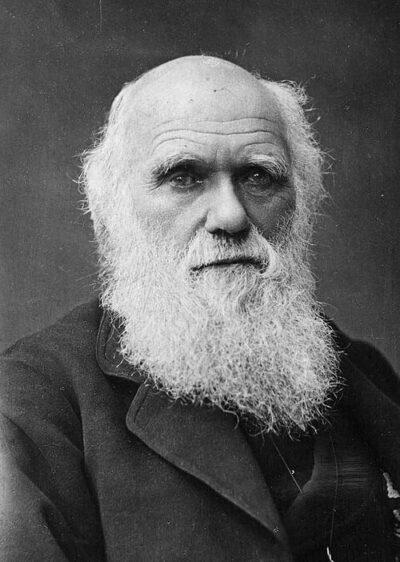
Picture: Charles Darwin, via Wikimedia Commons · Public domain