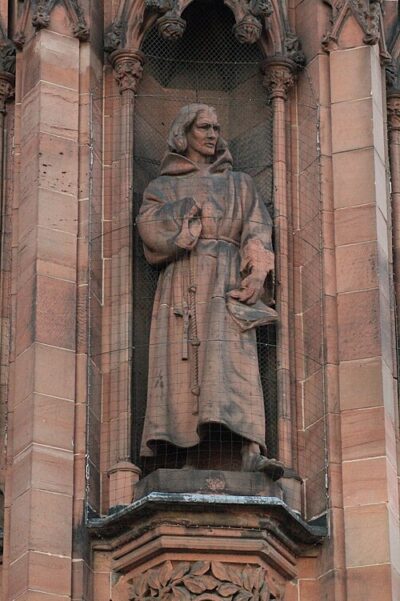
The Flyting of Dunbar and Kennedie
The Flyting of Dunbar and Kennedie is a poetic contest between two Scots poets c. 1500. It was written by William Dunbar and Walter Kennedy.
- Written by
- William Dunbar
- Genre
- poetry
All 9 facts, and where they come from
Facts
9 facts · 0 confirmed by two sources · 0 cited · 9 from one source
Where this comes from
Papalocal keeps its own record. It started from these sources; what each one said is kept here as it was copied, so a change on their side never changes this page by itself. Tap one to read its version.
What Wikidata says · copied November 18, 2026 · revision 2482253541
- Described as
- poetic contest between two Scots poets c. 1500
- Other names
- Flyting of Dunbar and Kennedie, The Flyting of Dumbar and Kennedie, The flyting of Dunbar and Kennedy
- What it is
- literary work; poetry
- Written by
- William Dunbar; Walter Kennedy
- Genre
- poetry
- Language
- Middle Scots; Middle English
- Named after
- William Dunbar; Walter Kennedy
- Wikipedias with a page
- 3
Wikidata item Q7734635 (wikidata.org/wiki/Q7734635), public domain (CC0). Copied 2026-11-18.
What Wikipedia says · copied November 18, 2026 · revision 1359836852
The Flyting of Dunbar and Kennedie is the earliest surviving example of the Scottish version of the flyting genre in poetry. The genre takes the form of a contest, or "war of words", between two poets, each trying to outclass the other in vituperation and verbal pyrotechnics. It is not certain how the work was composed, but it is likely to have been publicly performed, probably in the style of a poetic joust by the two combatants, William Dunbar and Walter Kennedy, before the court of James IV of Scotland.
The precise date of the event is not certain, but thought to have been around 1500. There are clues in the poem that suggest some of the features that the show must have contained. Each of the combatants had a commissar, both of whom are named in the work and sometimes directly addressed by the performers. These are (respectively) Sir John the Ross for Dunbar and Quentin Shaw for Kennedy, both of whom were actual persons. Shaw (certainly) and Ross (probably) were also poets, and it seems possible that they played some material part in the performance.
Ross, Shaw, and Kennedy are all three named as a group in the closing stanzas of Dunbar's Lament for the Makaris.
From the Wikipedia article “The Flyting of Dunbar and Kennedie” (en.wikipedia.org/wiki/The_Flyting_of_Dunbar_and_Kennedie), by its contributors, under CC BY-SA 4.0 (creativecommons.org/licenses/by-sa/4.0/). Copied 2026-11-18; not changed.
Confirmed Two sources agree. Cited One source, and it names where it got it. One source One source, without a reference of its own. Sources disagree The sources disagree. We show the best-supported value and keep theirs below.