
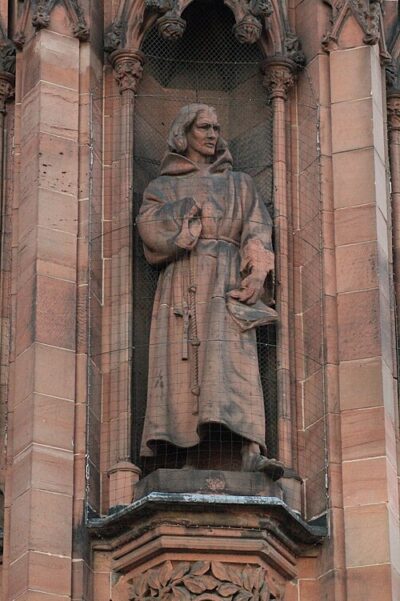
William Dunbar
William Dunbar was a medieval Scottish poet and civil servant. Born 1460, in East Lothian. Died 1520, in Edinburgh. Known for The Flyting of Dunbar and Kennedie, Tretis of the tua mariit wemen and the wedo and In Honour of the City of London. Educated at University of St Andrews.
Facts
18 facts · 0 confirmed by two sources · 3 cited · 15 from one source
Where this comes from
Papalocal keeps its own record. It started from these sources; what each one said is kept here as it was copied, so a change on their side never changes this page by itself. Tap one to read its version.
What Wikidata says · copied November 18, 2026 · revision 2563094220
- Described as
- medieval Scottish poet and civil servant
- Born
- 1460 · 5 references
- Died
- 1520 · 5 references
- Born in
- East Lothian
- Died in
- Edinburgh
- Citizen of
- Kingdom of Scotland
- Occupation
- poet; Catholic priest; writer · 2 references
- Worked for
- University of St Andrews
- Education
- University of St Andrews
- Known for
- The Flyting of Dunbar and Kennedie; Tretis of the tua mariit wemen and the wedo; In Honour of the City of London; The testament of Mr Andro Kennedy; Lament for the makars; The golden targe; The ballade of Lord Bernard Stewart
- Religion
- Catholic Church
- Wikipedias with a page
- 22
Wikidata item Q647150 (wikidata.org/wiki/Q647150), public domain (CC0). Copied November 18, 2026.
What Wikipedia says · copied November 18, 2026 · revision 1381543296
William Dunbar (1459 or 1460 – by 1530) was a Scottish makar, or court poet, active in the late fifteenth and early sixteenth centuries. He was closely associated with the court of King James IV and produced a large body of work in Scots distinguished by its great variation in themes and literary styles. He was probably a native of East Lothian, as assumed from a satirical reference in The Flyting of Dumbar and Kennedie. His surname is also spelt Dumbar.
From the Wikipedia article “William Dunbar” (en.wikipedia.org/wiki/William_Dunbar), by its contributors, under CC BY-SA 4.0 (creativecommons.org/licenses/by-sa/4.0/). Copied November 18, 2026; not changed.
Confirmed Two sources agree. Cited One source, and it names where it got it. One source One source, without a reference of its own. Sources disagree The sources disagree. We show the best-supported value and keep theirs below.
