The General Line
The General Line is a 1929 film by Sergei Eisenstein. It was directed by Grigori Aleksandrov. It stars Marfa Lapkina and Maxim Strauch.
- Released
- 1929
- Directed by
- Sergei Eisenstein
- Genre
- silent film
- Country of origin
- Soviet Union
All 13 facts, and where they come from
Facts
13 facts · 0 confirmed by two sources · 2 cited · 11 from one source
Where this comes from
Papalocal keeps its own record. It started from these sources; what each one said is kept here as it was copied, so a change on their side never changes this page by itself. Tap one to read its version.
What Wikidata says · copied November 17, 2026 · revision 2534814014
- Described as
- 1929 film by Sergei Eisenstein
- Other names
- General Line, Old and New, The Old and the New
- What it is
- film
- Directed by
- Sergei Eisenstein; Grigori Aleksandrov · 1 reference
- Screenplay by
- Sergei Eisenstein; Grigori Aleksandrov
- Produced by
- State Committee for Cinematography
- Starring
- Marfa Lapkina; Maxim Strauch · 1 reference
- Genre
- silent film; drama film
- Released
- 1929
- Original language
- Russian
- Country of origin
- Soviet Union
- Wikipedias with a page
- 19
Wikidata item Q2581338 (wikidata.org/wiki/Q2581338), public domain (CC0). Copied 2026-11-17.
What Wikipedia says · copied November 17, 2026 · revision 1358382358
The General Line, also known as Old and New (Russian: Старое и новое, romanized: Staroye i novoye), is a 1929 Soviet propaganda film directed by Sergei Eisenstein and Grigori Aleksandrov.
The General Line was begun in 1927 as a celebration of the collectivization of agriculture, as championed by old-line Bolshevik Leon Trotsky. Hoping to reach a wide audience, the director forsook his usual practice of emphasizing groups by concentrating on a single rural heroine. Eisenstein briefly abandoned this project to film October: Ten Days That Shook the World, in honour of the 10th anniversary of the Revolution. By the time he was able to return to this film, the Party's attitudes had changed and Trotsky had fallen from grace. As a result, the film was hastily re-edited and sent out in 1929 under a new title, The Old and the New. In later years, archivists restored The General Line to an approximation of Eisenstein's original concept. Much of the director's montage-like imagery—such as using simple props to trace the progress from the agrarian customs of the 19th-century to the more mechanized procedures of the 20th—was common to both versions of the film.
From the Wikipedia article “The General Line” (en.wikipedia.org/wiki/The_General_Line), by its contributors, under CC BY-SA 4.0 (creativecommons.org/licenses/by-sa/4.0/). Copied 2026-11-17; not changed.
Confirmed Two sources agree. Cited One source, and it names where it got it. One source One source, without a reference of its own. Sources disagree The sources disagree. We show the best-supported value and keep theirs below.
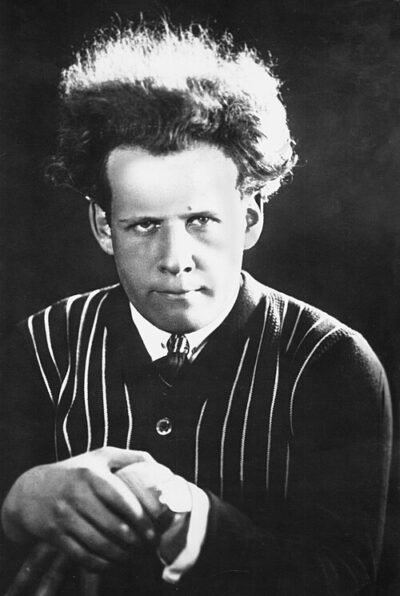
Picture: Sergei Eisenstein, via Wikimedia Commons · Public domain