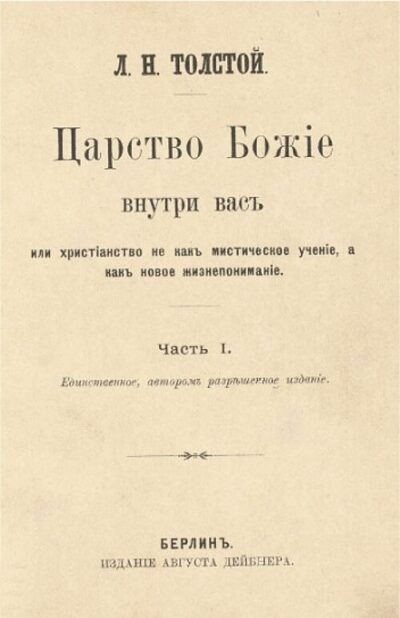
The Kingdom of God Is Within You
The Kingdom of God Is Within You is a philosophical treatise by Leo Tolstoy. It came out in 1893.
- Came out
- 1893
- Written by
- Leo Tolstoy
- Genre
- essay
All 5 facts, and where they come from
Facts
5 facts · 0 confirmed by two sources · 0 cited · 5 from one source
Where this comes from
Papalocal keeps its own record. It started from these sources; what each one said is kept here as it was copied, so a change on their side never changes this page by itself. Tap one to read its version.
What Wikidata says · copied November 17, 2026 · revision 2545470453
- Described as
- philosophical treatise by Leo Tolstoy
- What it is
- literary work
- Written by
- Leo Tolstoy
- Genre
- essay
- Language
- Russian
- Came out
- 1893
- Wikipedias with a page
- 24
Wikidata item Q143931 (wikidata.org/wiki/Q143931), public domain (CC0). Copied 2026-11-17.
What Wikipedia says · copied November 17, 2026 · revision 1384227335
The Kingdom of God Is Within You (pre-reform Russian: Царство Божіе внутри васъ; post-reform Russian: Царство Божие внутри вас, romanized: Tsárstvo Bózhiye vnutrí vas) is a non-fiction book written by Leo Tolstoy. A Christian anarchist philosophical treatise, the book was first published in Germany in 1894 after being banned in his home country of Russia. It is the culmination of 30 years of Tolstoy's thinking and lays out a new organization for society based on an interpretation of Christianity focusing on universal love.
The Kingdom of God Is Within You is a key text for Tolstoyan proponents of nonviolence, of nonviolent resistance, and of the Christian anarchist movement.
From the Wikipedia article “The Kingdom of God Is Within You” (en.wikipedia.org/wiki/The_Kingdom_of_God_Is_Within_You), by its contributors, under CC BY-SA 4.0 (creativecommons.org/licenses/by-sa/4.0/). Copied 2026-11-17; not changed.
Confirmed Two sources agree. Cited One source, and it names where it got it. One source One source, without a reference of its own. Sources disagree The sources disagree. We show the best-supported value and keep theirs below.
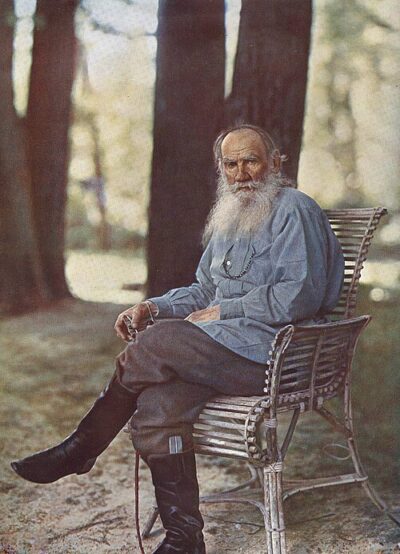
Picture: Leo Tolstoy, via Wikimedia Commons · Public domain