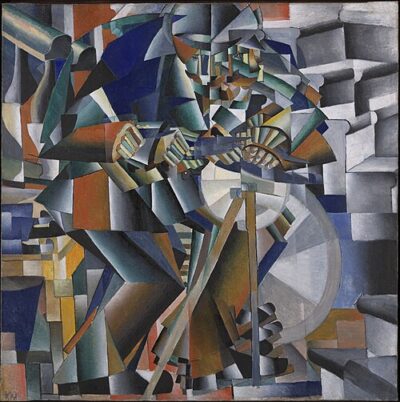
The Knife Grinder
The Knife Grinder is a painting by Kazimir Malevich. It came out in 1912.
- Came out
- 1912
- Created by
- Kazimir Malevich
All 3 facts, and where they come from
Facts
3 facts · 0 confirmed by two sources · 1 cited · 2 from one source
Where this comes from
Papalocal keeps its own record. It started from these sources; what each one said is kept here as it was copied, so a change on their side never changes this page by itself. Tap one to read its version.
What Wikidata says · copied November 17, 2026 · revision 2566944582
- Described as
- painting by Kazimir Malevich
- Other names
- The Knife Grinder or Principle of Glittering, Tochil’schik Printsip Mel’kaniia, The Knifegrinder
- What it is
- painting
- Created by
- Kazimir Malevich
- Came out
- 1912 · 1 reference; 1912
- Wikipedias with a page
- 9
Wikidata item Q18112999 (wikidata.org/wiki/Q18112999), public domain (CC0). Copied 2026-11-17.
What Wikipedia says · copied November 17, 2026 · revision 1384815352
The Knifegrinder or Principle of Glittering (Russian: Точильщик, romanized: Tochil'schik Printsip Mel'kaniia), also called The Knifegrinder (The Glittering Edge), and sometimes shortened to simply The Knifegrinder, is a 1912–1913 cubo-futurist painting by the artist Kazimir Malevich, hence the fragmentation of form associated with futurism as well as the abstract geometry related to cubism. As of 2014, it is in the collection of the Yale University Art Gallery in New Haven, Connecticut.
From the Wikipedia article “The Knifegrinder (Malevich)” (en.wikipedia.org/wiki/The_Knifegrinder_(Malevich)), by its contributors, under CC BY-SA 4.0 (creativecommons.org/licenses/by-sa/4.0/). Copied 2026-11-17; not changed.
Confirmed Two sources agree. Cited One source, and it names where it got it. One source One source, without a reference of its own. Sources disagree The sources disagree. We show the best-supported value and keep theirs below.
Picture: Kazimir Malevich, via Wikimedia Commons · Public domain