
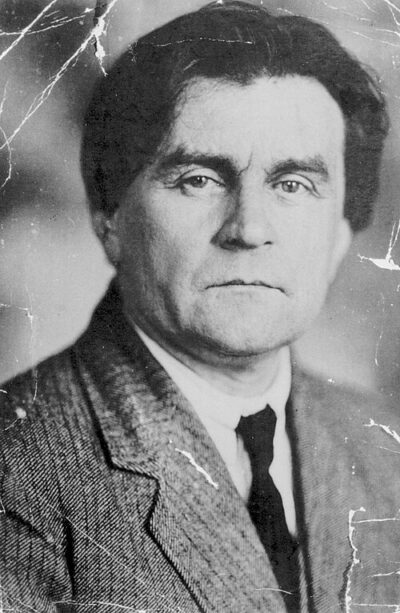
Kazimir Malevich
Kazimir Malevich was a Russian avant-garde artist of Polish ancestry. Founder of the Suprematist movement. Born February 23, 1879, in Kyiv. Died May 15, 1935, in Saint Petersburg. Positions held include museum director. Known for Black Square (1915), Suprematist Composition and Suprematist Composition: White on White.
Facts
37 facts · 2 confirmed by two sources · 21 cited · 14 from one source
What’s different
- Born: we show February 23, 1879 (Confirmed). Wikidata also lists February 11, 1879
Where this comes from
Papalocal keeps its own record. It started from these sources; what each one said is kept here as it was copied, so a change on their side never changes this page by itself. Tap one to read its version.
What Wikidata says · copied November 16, 2026 · revision 2569929556
- Described as
- Russian avant-garde artist of Polish ancestry. Founder of the Suprematist movement (1879–1935)
- Other names
- Малевиць «Азимир Севериновиц», Казимир Малевич, Kazymyr Malevych, Malevich, Т. Малевича, Казимир Малевіт, Казимир Шеверінович Малевич, Kazimierz Malewicz, Kazymyr Severynovych Malevych, Казімеж Малевич, Казимир Северинович Малевич, Kazimir Severinovich Malevich
- Born
- February 11, 1879 · 1 reference; February 23, 1879 · 1 reference
- Died
- May 15, 1935 · 14 references
- Born in
- Kyiv · 5 references
- Died in
- Saint Petersburg · 4 references
- Cause of death
- prostate cancer
- Name at birth
- Казиміръ Малевичъ · 1 reference
- Citizen of
- Russian Empire; Soviet Union
- Occupation
- painter · 4 references; sculptor · 3 references; printmaker · 3 references; scenographer · 1 reference; costume designer · 1 reference; draftsperson · 3 references; art theorist · 2 references; designer · 2 references
- Positions held
- museum director · 1 reference
- Worked for
- Vitebsk People's Art School
- Member of
- Supremus
- Genre
- scenography; painting · 1 reference; abstract art · 1 reference; still life · 1 reference; figurative art · 1 reference
- Known for
- Black Square (1915); Suprematist Composition; Suprematist Composition: White on White; An Englishman in Moscow; The Knife Grinder
- Field
- avant-garde · 1 reference; visual art activity · 1 reference; art history · 1 reference; Suprematism · 1 reference; visual arts · 1 reference; abstract art · 1 reference
- Spouse
- Kazimiera Zgleitc; Sofia Rafalovich
- Wikipedias with a page
- 85
Wikidata item Q130777 (wikidata.org/wiki/Q130777), public domain (CC0). Copied November 16, 2026.
What Wikipedia says · copied November 16, 2026 · revision 1384335207
Kazimir Severinovich Malevich (23 February [O.S. 11 February] 1879 – 15 May 1935) was a Russian avant-garde artist and art theorist, whose work and writings pioneered the development of abstract painting in the 20th century. He is best known as the founder of Suprematism, a radically non-objective form of painting he introduced in 1915.
Born in Kiev, modern-day Ukraine, to an ethnic Polish family, Malevich worked primarily in Russia and became a leading figure of the Russian avant-garde. His work has also been associated with the Ukrainian avant-garde. Early in his career, he worked in multiple styles, assimilating Impressionism, Symbolism, Fauvism, and Cubism through reproductions and the works acquired by contemporary Russian collectors. In the early 1910s, he exhibited alongside other Russian avant-garde artists, including Mikhail Larionov and Natalia Goncharova. In 1915, working in a Cubo-Futurist mode, Malevich developed Suprematism, a system of pure geometric abstraction on monochromatic grounds. His Black Square (1915), first shown at the Last Futurist Exhibition 0,10 in Petrograd, marked a decisive break with representational painting. He set out his theory in the brochure From Cubism and Futurism to Suprematism, published to accompany the exhibition.
His trajectory mirrored the upheavals around the October Revolution of 1917. In 1918, Malevich began teaching in Vitebsk along with Marc Chagall. In 1919, he founded the UNOVIS artists collective and had a solo show at the Sixteenth State Exhibition in Moscow. His reputation spread westward with solo exhibitions in Warsaw and Berlin in 1927, the only time he ever left Russia. From 1928 to 1930 he taught at the Kiev Art Institute alongside Alexander Bogomazov, Victor Palmov, and Vladimir Tatlin, while publishing in the Kharkiv magazine Nova Generatsiia. In 1930, he was briefly arrested and interrogated by the OGPU in Leningrad. By the early 1930s, Stalin's restrictive cultural policy and the subsequent imposition of Socialist Realism had prompted Malevich to return to figuration and to paint in a representational style. Diagnosed with cancer in 1933, he was not allowed to leave the Soviet Union to seek treatment abroad. While constrained by his progressing illness and Stalin's cultural policies, Malevich painted and exhibited his work until the end of his life. He died on 15 May 1935, at age 56.
His art and his writings influenced Eastern and Central European contemporaries such as El Lissitzky, Lyubov Popova, Alexander Rodchenko and Henryk Stażewski, as well as generations of later abstract artists, such as Ad Reinhardt and the Minimalists. He was celebrated posthumously in major exhibits at the Museum of Modern Art (1936), the Guggenheim Museum (1973), and the Stedelijk Museum in Amsterdam (1989), which has a large collection of his work. In the 1990s, the ownership claims of museums to many Malevich works began to be disputed by his heirs.
- Born, in its opening lines
- February 23, 1879
- Died, in its opening lines
- May 15, 1935
From the Wikipedia article “Kazimir Malevich” (en.wikipedia.org/wiki/Kazimir_Malevich), by its contributors, under CC BY-SA 4.0 (creativecommons.org/licenses/by-sa/4.0/). Copied November 16, 2026; not changed.
Confirmed Two sources agree. Cited One source, and it names where it got it. One source One source, without a reference of its own. Sources disagree The sources disagree. We show the best-supported value and keep theirs below.
