The Lady of Shalott
The Lady of Shalott is a 1832 Victorian ballad by Alfred Tennyson. It came out in 1833. It stars Flora Finch.
- Published
- 1833
- Written by
- Alfred Tennyson
- Genre
- poetry
All 6 facts, and where they come from
Facts
6 facts · 0 confirmed by two sources · 0 cited · 6 from one source
Where this comes from
Papalocal keeps its own record. It started from these sources; what each one said is kept here as it was copied, so a change on their side never changes this page by itself. Tap one to read its version.
What Wikidata says · copied November 17, 2026 · revision 2520283004
- Described as
- 1832 Victorian ballad by Alfred Tennyson
- Other names
- Lady of Shalott
- What it is
- literary work
- Written by
- Alfred Tennyson
- Starring
- Flora Finch
- Genre
- poetry
- Published
- 1833
- Language
- English
- Wikipedias with a page
- 25
Wikidata item Q2091538 (wikidata.org/wiki/Q2091538), public domain (CC0). Copied 2026-11-17.
What Wikipedia says · copied November 17, 2026 · revision 1379321525
"The Lady of Shalott" () is a lyrical ballad by the 19th-century English poet Alfred Tennyson and one of his best-known works. Inspired by the 13th-century Italian short prose text La Damigella di Scalot, the poem tells the tragic story of Elaine of Astolat, a young noblewoman stranded in a tower up the river from Camelot. Tennyson wrote two versions of the poem, one published in 1832 (in Poems, incorrectly dated 1833), of 20 stanzas, the other in 1842, of 19 stanzas (also in a book named Poems), and returned to the story in "Lancelot and Elaine". The vivid medieval romanticism and enigmatic symbolism of "The Lady of Shalott" inspired many painters, especially the Pre-Raphaelites and their followers, as well as other authors and artists.
From the Wikipedia article “The Lady of Shalott” (en.wikipedia.org/wiki/The_Lady_of_Shalott), by its contributors, under CC BY-SA 4.0 (creativecommons.org/licenses/by-sa/4.0/). Copied 2026-11-17; not changed.
Confirmed Two sources agree. Cited One source, and it names where it got it. One source One source, without a reference of its own. Sources disagree The sources disagree. We show the best-supported value and keep theirs below.
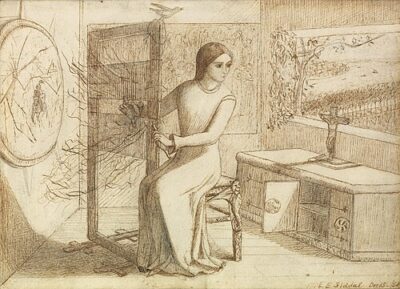
Picture: Elizabeth Siddal, via Wikimedia Commons · Public domain