
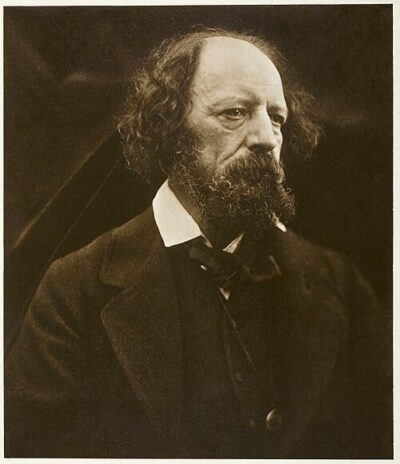
Alfred Tennyson
Alfred Tennyson was a British Poet Laureate. Born August 6, 1809, in Somersby. Died October 6, 1892, in Aldworth. Positions held include member of the House of Lords and Poet Laureate of the United Kingdom (1850–1892). Known for The Charge of the Light Brigade, The Lady of Shalott and Idylls of the King. Educated at Trinity College and King Edward VI Grammar School. Awards include Fellow of the Royal Society and Chancellor's Gold Medal.
Facts
39 facts · 2 confirmed by two sources · 21 cited · 16 from one source
Where this comes from
Papalocal keeps its own record. It started from these sources; what each one said is kept here as it was copied, so a change on their side never changes this page by itself. Tap one to read its version.
What Wikidata says · copied November 16, 2026 · revision 2570000985
- Described as
- British Poet Laureate (1809–1892)
- Other names
- Alfred Tennyson d'Eyncourt, Lord Tennyson Alfred, Alfred Tennyson Tennyson, Alfred, Lord Tennyson, Alfred Tennyson, Baron Tennyson, A. Tennyson, 1st Baron Tennyson of Aldworth and Freshwater Alfred Tennyson, Alfred Tennyson, 1st Baron Tennyson, Alcibiades, Tennyson, Lord Tennyson, Alfred Lord Tennyson
- Born
- August 6, 1809 · 14 references
- Died
- October 6, 1892 · 14 references
- Born in
- Somersby · 2 references
- Died in
- Aldworth · 3 references
- Buried in
- Westminster Abbey
- Citizen of
- United Kingdom of Great Britain and Ireland
- Occupation
- poet · 1 reference; politician · 1 reference; writer · 2 references
- Positions held
- member of the House of Lords; Poet Laureate of the United Kingdom (1850–1892)
- Education
- Trinity College · 1 reference; King Edward VI Grammar School
- Member of
- Royal Society of London; American Academy of Arts and Sciences
- Known for
- The Charge of the Light Brigade; The Lady of Shalott; Idylls of the King; The Princess
- Awards
- Fellow of the Royal Society; Chancellor's Gold Medal
- Field
- poetry · 1 reference
- Spouse
- Emily Tennyson, Lady Tennyson (1850–) · 2 references
- Children
- Hallam Tennyson, 2nd Baron Tennyson · 1 reference; Lionel Tennyson · 2 references; [Unnamed] Tennyson · 1 reference
- Father
- George Clayton Tennyson · 1 reference
- Mother
- Elizabeth Fytche · 2 references
- Siblings
- Charles Tennyson Turner · 1 reference; Emilia Tennyson; Edward Tennyson · 1 reference; Emily Tennyson · 1 reference; Mary Tennyson · 1 reference; Frederick Tennyson · 1 reference; Horatio Tennyson · 1 reference; George Tennyson · 1 reference; Cecilia Tennyson · 1 reference; Septimus Tennyson · 1 reference
- Religion
- Anglicanism
- Wikipedias with a page
- 118
Wikidata item Q173869 (wikidata.org/wiki/Q173869), public domain (CC0). Copied November 16, 2026.
What Wikipedia says · copied November 16, 2026 · revision 1385856414
Alfred Tennyson, 1st Baron Tennyson (; 6 August 1809 – 6 October 1892) was an English poet. He was Poet Laureate of the United Kingdom during much of Queen Victoria's reign. In 1829 he was awarded the Chancellor's Gold Medal at Cambridge for one of his first pieces, "Timbuktu". He published his first solo collection of poems, Poems, Chiefly Lyrical, in 1830. "Claribel" and "Mariana", which remain some of Tennyson's most celebrated poems, were included in this volume. Some critics described Tennyson as overly sentimental. However, his poems proved popular and brought Tennyson to the attention of well-known writers of the day, including Samuel Taylor Coleridge. Tennyson's early poetry, with its medievalism and powerful visual imagery, was a major influence on the Pre-Raphaelite Brotherhood.
Tennyson also focused on short lyrics, such as "Break, Break, Break", "The Charge of the Light Brigade", "Tears, Idle Tears", and "Crossing the Bar". Much of his verse was based on classical mythological themes, such as "Ulysses" and "The Lotos-Eaters". "In Memoriam A.H.H." was written to commemorate his friend Arthur Hallam, a fellow poet and student at Trinity College, Cambridge, after he died of a stroke at the age of 22. Tennyson also wrote notable blank verse, including Idylls of the King, "Ulysses", and "Tithonus". During his career, Tennyson attempted drama, but his plays enjoyed little success.
A number of phrases from Tennyson's work have become commonplace in the English language, including "Nature, red in tooth and claw" ("In Memoriam A.H.H."), "'Tis better to have loved and lost / Than never to have loved at all", "Theirs not to reason why, / Theirs but to do and die", "My strength is as the strength of ten, / Because my heart is pure", "To strive, to seek, to find, and not to yield", "Knowledge comes, but Wisdom lingers", and "The old order changeth, yielding place to new". He is the ninth most frequently quoted writer in The Oxford Dictionary of Quotations.
- Born, in its opening lines
- August 6, 1809
- Died, in its opening lines
- October 6, 1892
From the Wikipedia article “Alfred, Lord Tennyson” (en.wikipedia.org/wiki/Alfred,_Lord_Tennyson), by its contributors, under CC BY-SA 4.0 (creativecommons.org/licenses/by-sa/4.0/). Copied November 16, 2026; not changed.
Confirmed Two sources agree. Cited One source, and it names where it got it. One source One source, without a reference of its own. Sources disagree The sources disagree. We show the best-supported value and keep theirs below.
