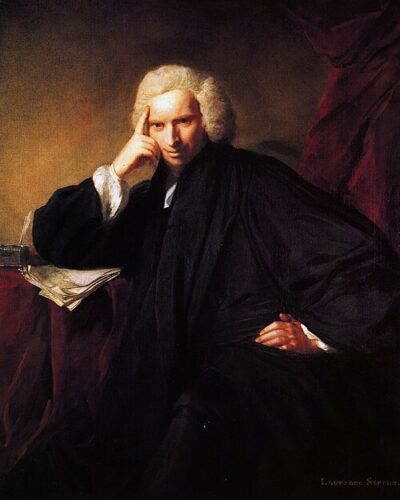
The Life and Opinions of Tristram Shandy, Gentleman
The Life and Opinions of Tristram Shandy, Gentleman is a novel by Laurence Sterne. It came out in 1759.
- Published
- 1759
- Written by
- Laurence Sterne
- Genre
- satirical fiction
- Country of origin
- Kingdom of Great Britain
All 9 facts, and where they come from
Facts
9 facts · 0 confirmed by two sources · 0 cited · 9 from one source
Where this comes from
Papalocal keeps its own record. It started from these sources; what each one said is kept here as it was copied, so a change on their side never changes this page by itself. Tap one to read its version.
What Wikidata says · copied November 17, 2026 · revision 2555911351
- Described as
- novel by Laurence Sterne
- Other names
- Tristram Shandy
- What it is
- literary work
- Written by
- Laurence Sterne
- Publisher
- James Dodsley
- Genre
- satirical fiction; picaresque novel; metafiction
- Published
- 1759
- Language
- English
- Country of origin
- Kingdom of Great Britain
- Wikipedias with a page
- 34
Wikidata item Q1164083 (wikidata.org/wiki/Q1164083), public domain (CC0). Copied 2026-11-17.
What Wikipedia says · copied November 17, 2026 · revision 1384365275
The Life and Opinions of Tristram Shandy, Gentleman, often known simply as Tristram Shandy, is a humorous novel by Laurence Sterne. It was published from 1759 to 1767, in nine volumes across five instalments. The novel purports to be a memoir, but the titular Tristram is an effusive and digressive narrator who begins the story with his conception and does not reach a description of his birth until the third volume. While attempting to explain four accidents in his early life which have doomed him to an unhappy future, Tristram describes domestic conflicts between his irritable father Walter and his gentle Uncle Toby, and inserts humorous discourses on a range of intellectual topics.
Stylistically, Sterne is influenced by the earlier satirists Alexander Pope, Jonathan Swift, Rabelais, and Cervantes. The novel is characterised by innuendo, especially sexual double entendre and aposiopesis (unfinished sentences). Sterne burlesques serious writers and genres, particularly parodying Robert Burton's The Anatomy of Melancholy and the genre of consolatio. The novel is also remembered for surprising visual elements, such as blank, black, and marbled pages; entire paragraphs censored with asterisks; and inserted diagrams.
Tristram Shandy was Sterne's first novel, and immediately transformed his life from that of an obscure rural clergyman to that of a literary celebrity. Eighteenth century audiences expressed some reservations about its daring and bawdy humour, especially given Sterne's religious profession, but praised its originality and its moments of sentimental morality. Over time, it has been an influential novel with a mixed reputation: Victorian audiences criticised it as obscene, but modernist and postmodernist authors embraced it in the twentieth century. Adaptations include the 2006 film A Cock and Bull Story, starring Steve Coogan and Rob Brydon as they metafictionally struggle to make the film.
From the Wikipedia article “The Life and Opinions of Tristram Shandy, Gentleman” (en.wikipedia.org/wiki/The_Life_and_Opinions_of_Tristram_Shandy,_Gentleman), by its contributors, under CC BY-SA 4.0 (creativecommons.org/licenses/by-sa/4.0/). Copied 2026-11-17; not changed.
Confirmed Two sources agree. Cited One source, and it names where it got it. One source One source, without a reference of its own. Sources disagree The sources disagree. We show the best-supported value and keep theirs below.
Picture: Wikimedia Commons: SterneShandy.png · See Commons file page