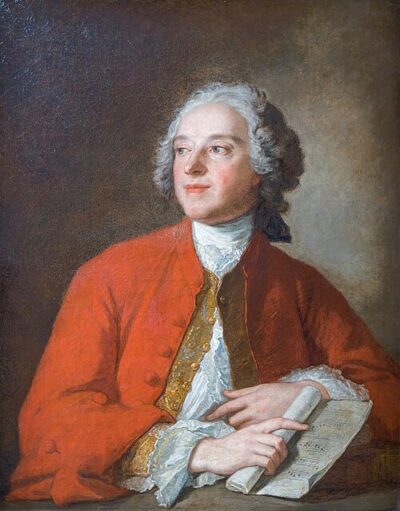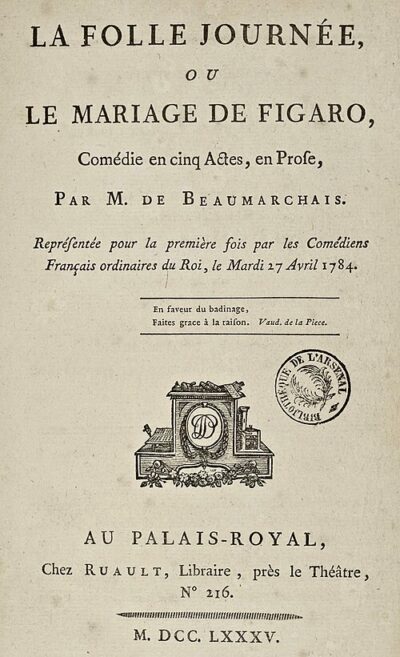
The Marriage of Figaro
The Marriage of Figaro is a French play by Pierre Beaumarchais. It came out in 1778. It was written by Pierre-Augustin de Beaumarchais.
- Published
- 1778
- Came out
- September 23, 1783
- Written by
- Pierre-Augustin de Beaumarchais
- Genre
- comedy
- Country of origin
- France
All 8 facts, and where they come from
Facts
8 facts · 0 confirmed by two sources · 0 cited · 8 from one source
Where this comes from
Papalocal keeps its own record. It started from these sources; what each one said is kept here as it was copied, so a change on their side never changes this page by itself. Tap one to read its version.
What Wikidata says · copied November 17, 2026 · revision 2567033273
- Described as
- French play by Pierre Beaumarchais
- What it is
- literary work
- Written by
- Pierre-Augustin de Beaumarchais
- Publisher
- Nicolas Ruault
- Genre
- comedy
- Published
- 1778
- Language
- French
- Country of origin
- France
- Came out
- September 23, 1783
- Wikipedias with a page
- 21
Wikidata item Q1199684 (wikidata.org/wiki/Q1199684), public domain (CC0). Copied 2026-11-17.
What Wikipedia says · copied November 17, 2026 · revision 1368908550
The Marriage of Figaro (French: La Folle Journée, ou Le Mariage de Figaro ("The Mad Day, or The Marriage of Figaro")) is a comedy in five acts, written in 1778 by Pierre-Augustin de Beaumarchais. This play is the second in the Figaro trilogy, preceded by The Barber of Seville and followed by The Guilty Mother.
In the first play, The Barber, the story begins with a simple love triangle in which a Spanish count has fallen in love with a girl called Rosine. He disguises himself to ensure that she will love him back for his character, not his wealth. But this is all foiled when Rosine's guardian, Doctor Bartholo, who wants her hand in marriage, confines her to the house. The Count runs into an ex-servant of his (now a barber), Figaro, and pressures him into setting up a meeting between the Count and Rosine. He succeeds and the lovers are married to end the first part of the trilogy.
The Marriage was written as a sequel to The Barber. In his preface to the play, Beaumarchais says that Louis François, Prince of Conti, had requested it. The play's denunciation of aristocratic privilege has been characterised as foreshadowing the French Revolution. The revolutionary leader Georges Danton said that the play "killed off the nobility"; in exile, Napoleon Bonaparte called it "the Revolution already put into action."
Thanks to the great popularity of its predecessor, The Marriage of Figaro opened to enormous success; it was said to have grossed 100,000 francs in the first twenty showings, and the theatre was so packed that three people were reportedly crushed to death in the opening-night crowd.
The play formed the basis for an opera with a libretto by Lorenzo Da Ponte and music by Mozart, also called The Marriage of Figaro (1786). In 1799, another opera based on the same play, La pazza giornata, ovvero Il matrimonio di Figaro, was produced in Venice with a libretto by Gaetano Rossi and music by Marcos Portugal.
From the Wikipedia article “The Marriage of Figaro (play)” (en.wikipedia.org/wiki/The_Marriage_of_Figaro_(play)), by its contributors, under CC BY-SA 4.0 (creativecommons.org/licenses/by-sa/4.0/). Copied 2026-11-17; not changed.
Confirmed Two sources agree. Cited One source, and it names where it got it. One source One source, without a reference of its own. Sources disagree The sources disagree. We show the best-supported value and keep theirs below.
Picture: Unknown author, via Wikimedia Commons · Public domain