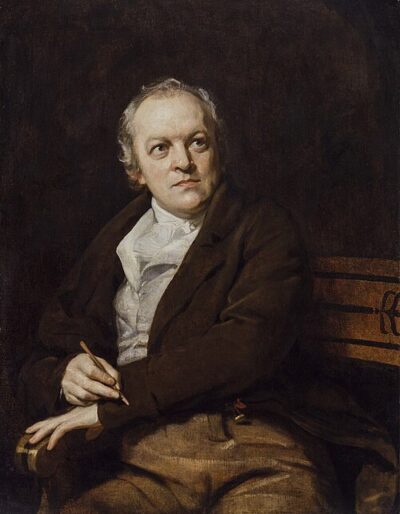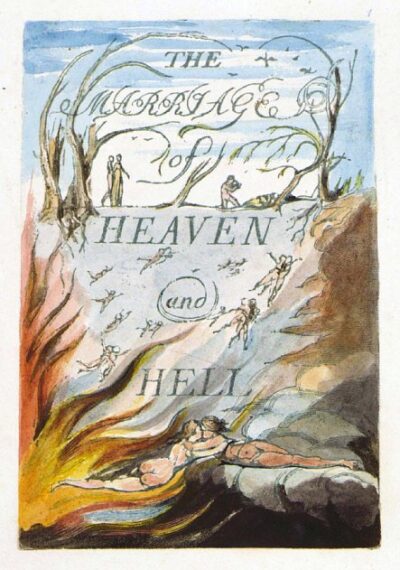
The Marriage of Heaven and Hell
The Marriage of Heaven and Hell is a literary work by William Blake. It came out in 1793.
- Published
- 1793
- Written by
- William Blake
- Genre
- Menippean satire
All 5 facts, and where they come from
Facts
5 facts · 0 confirmed by two sources · 2 cited · 3 from one source
Where this comes from
Papalocal keeps its own record. It started from these sources; what each one said is kept here as it was copied, so a change on their side never changes this page by itself. Tap one to read its version.
What Wikidata says · copied November 17, 2026 · revision 2515894638
- Described as
- literary work by William Blake
- What it is
- literary work
- Written by
- William Blake · 1 reference
- Genre
- Menippean satire · 1 reference
- Published
- 1793
- Language
- English
- Wikipedias with a page
- 22
Wikidata item Q1132673 (wikidata.org/wiki/Q1132673), public domain (CC0). Copied 2026-11-17.
What Wikipedia says · copied November 17, 2026 · revision 1372131544
The Marriage of Heaven and Hell is a book by the English poet and printmaker William Blake. It is a series of texts written in imitation of biblical prophecy but expressing Blake's own intensely personal Romantic and revolutionary beliefs. Like his other books, it was published as printed sheets from etched plates containing prose, poetry, and illustrations. The plates were then coloured by Blake and his wife, Catherine.
It opens with an introduction of a short poem entitled "Rintrah roars and shakes his fires in the burden'd air".
William Blake claims that John Milton was a true poet and his epic poem Paradise Lost was "of the Devil's party without knowing it". He also claims that Milton's Satan was truly his Messiah.
The work was composed between 1790 and 1793, in the period of radical ferment and political conflict during the French Revolution. The title is an ironic reference to Emanuel Swedenborg's theological work Heaven and Hell, published in Latin 33 years earlier. Swedenborg is directly cited and criticised by Blake in several places in the Marriage. Though Blake was influenced by his grand and mystical cosmic conception, Swedenborg's conventional moral strictures and his Manichaean view of good and evil led Blake to express a deliberately depolarised and unified vision of the cosmos in which the material world and physical desire are equally part of the divine order; hence, a marriage of heaven and hell. The book is written in prose, except for the opening "Argument" and the "Song of Liberty". The book describes the poet's visit to Hell, a device adopted by Blake from Dante's Divine Comedy and Milton's Paradise Lost.
From the Wikipedia article “The Marriage of Heaven and Hell” (en.wikipedia.org/wiki/The_Marriage_of_Heaven_and_Hell), by its contributors, under CC BY-SA 4.0 (creativecommons.org/licenses/by-sa/4.0/). Copied 2026-11-17; not changed.
Confirmed Two sources agree. Cited One source, and it names where it got it. One source One source, without a reference of its own. Sources disagree The sources disagree. We show the best-supported value and keep theirs below.
Picture: William Blake, via Wikimedia Commons · Public domain